Showing posts with label life skills. Show all posts

Sunday, October 22, 2017

Important Information Children Should Know – Life Skills

Important Information Children Should Know Life SkillsImportant Information Children Should Know Life Skills

As children move through development stages, there are many important life skills that need to be learned.  Whether it be dressing skills, toilet training, manners, etc, it takes children time and practice.  It is also crucial for children to learn important facts about themselves, their school and their community to stay safe and knowledgeable.  This also takes time and practice.

Here is a list of important information children should know:

  1. Full Name
  2. Home Address
  3. Phone Number
  4. Parent(s) Names
  5. Parent(s) Phone Number
  6. How and When to Dial 911
  7. Emergency Contact Name
  8. Emergency Contact Phone Number
  9. Birthday
  10. Medical Issues

Children can practice and learn these facts by matching up the answers or writing the correct responses.  You can download this free printable to practice writing your home address.

Here are some general guidelines on when children are able to master learning this information:

  • Identifies city or town where they live – 3.8 to 4.6 years old
  • Tells month of birth – 4 to 4.10 years old
  • Identifies street name and town where they live – 4 – 5.6 years old
  • Recites phone number 4 – 5.6 years old
  • Tells father and mother’s first and last names – 4.6 – 5.2 years old
  • Identifies 911 and when to use it – 4.6 – 5.6 years old
  • Tells house number, street, and town – 4.6 – 5.6 years old
  • Recited month and day of birth – 5.4 – 6 years old

Reference: Teaford, P et al (2010). HELP® Checklist 3-6 Checklist. VORT Corporation.

You can help children practice and learn these important facts with My Information Binder.

My Information Binder Learn Important Life Skills

The My Information Binder digital download helps children learn important life skill information.  Students can practice matching or handwriting their names, address, phone number, emergency info, school info and more.  This 29 page PDF black and white, digital document is delivered electronically immediately following payment.  The picture images are suitable for all ages.

You can print the handwriting practice pages (similar to a Zaner-Bloser® style font) or create a word bank to match up the answer.  You can type the word bank directly into the PDF document to create the matching answers.

The My Information Binder includes the following pages:

  1. Important Information (Name, Age, Birthday, Phone Number)
  2. Home Address
  3. Phone Number
  4. Emergency Information
  5. School Information
  6. Today’s Date
  7. Weather Calendar
  8. Computer Information
  9. Daily Routine
  10. Daily Schedule
  11. Answer Key/Word Bank (type in the words directly in the PDF document to create matching answer key)
  12. Word Bank for Phone Number and Date
  13. Word Bank for Days of the Week and Year
  14. Word Bank for Months
  15. Word Bank with 16 Picture and Word Icons for School Routine/Periods
  16. Weather Picture Icons for Weather Calendar

FIND OUT MORE INFORMATION.

Important Information Children Should Know Life Skills


The post Important Information Children Should Know – Life Skills appeared first on Your Therapy Source.

Wednesday, July 27, 2016

Developmental Progression of Community Skills

Developmental Progression of Community Skills

The Functional Skills for Kids is a 12-month long series written by occupational and physical therapy bloggers on the development of 12 functional skills for children. This month the topic is community skills and this post will discuss the developmental progression of community skills.  Each month throughout 2016, we will discuss the development of one functional skill in children addressing the many components of that skill.  The ability to complete the functional task of navigating the community develops along a continuum.  Children need motor skills, visual perceptual skills, balance skills and safety awareness to be independent in the community.  The developmental progression of the following community skills will be addressed: walking up/down ramps, curbs, different surfaces, bike riding, crossing streets and on/off different modes of transportation.

DEVELOPMENTAL PROGRESSION OF WALKING ON DIFFERENT SURFACES, UP/DOWN RAMPS AND CURBS

After children have moved through the developmental progression of rolling, crawling, standing and walking higher level motor skills begin to be mastered.  Children normally learn how to walk on level, flat surfaces.  When the flooring changes from hard flooring to rugs children need to adapt and lift those little legs just a little higher to clear the rug.  When a new walker heads outdoors, uneven surfaces require additional righting reactions and balance skills.  The feet tend to separate to widen the base of support and the knees may bend to lower the center of gravity.

Learning to walk on uneven surfaces


Around 18 months to 24 months+, some children will begin to step on and off a curb without a hand hold.  Jumping down from the curb (with one foot leading) quickly follows.  Children develop the ability to safely go up and down ramps around the same developmental age.  Children can swiftly and safely run up and down ramps around 2-3 years of age.

Developmental Progression of Bike Riding

DEVELOPMENTAL PROGRESSION OF BIKE RIDING

First, children learn how to propel a ride on toy around 18-24 months with their feet and progress to pedaling a tricycle around 36 months of age.   Around 5+ years of age, most children have developed the coordination, balance and motor planning to ride a bicycle without training wheels.  At this age though, safety awareness is a concern in terms of avoiding obstacles and cars so close supervision is a must with significant practice time.  Around 6 years+ of age, children begin to develop improved safety awareness but are still at risk for injuries and can use hand brakes.  Around 9-12 years of age, children can shift gears on a bicycle and are fairly aware of traffic laws. Children under age 10 ride primarily on sidewalks, playgrounds, and neighborhood streets.  Bicycle riders over age 10 are more likely to be found on neighborhood streets, bike paths, or major thoroughfares.

CROSSING THE STREET

As children get older and begin to explore their communities, sometimes parents think children are able to handle traffic safely by themselves before they may be ready.  Young children cannot reliably and consistently accurately judge the speed or distance of oncoming cars.  Children under age 9-10 should cross the street with an adult.  From a young age, teach and practice with children to :

  1. look left, right, then left again before stepping into the street.
  2. cross the street at designated crossings.
  3. cross only when there are no cars coming.
  4. walk on the sidewalk.
  5. walk on the side of the street facing traffic if there are no sidewalks.
  6. recognize crossing signals.
  7. be extra cautious when crossing where cars are parked on the street.

GETTING ON AND OFF THE SCHOOL BUS

By four years of age, most children can go up and down regular sized stairs without using a handrail.  To get on/off the school bus, children need to to be able to independently climb up and down taller bus stairs using the handrail.  Most children are able to do this by kindergarten age.  There are no standard, specific age guidelines for when children are developmentally ready to  wait, get on or get off a bus independently.  When children do start to ride the bus it is important to teach and practice with children to:

  1. stand at least three giant steps (6 feet) away from the curb.
  2. walk on the sidewalk or along the side of the road until you are five giant steps (10 feet) ahead of the bus if you have to cross the street before getting on the bus.
  3. make sure the bus driver can see you and you can see the bus driver.
  4. never walk behind the bus.
  5. never try to pick it up anything you dropped until you get permission from the bus driver.

Children will develop at their own pace independence with life skills through education and practice.

Stop by to see what the other occupational therapists and physical therapists in the Functional Skills for Kids series have written on the development of community skills.

How to Support Your Child’s Core Strength Development Every Day | Miss Jaime, O.T.

Tips to Help “Sensory Kids” at Stores and Malls | Mama OT

Attention and Behavior Concerns and Independence in the Community | Sugar Aunts

Modifications for Kids with Special Needs in the Community  | Growing Hands-On Kids

Calming Games and Activities for Outings  |  The Inspired Treehouse

Working on following Directions When Out  | Therapy Fun Zone

Using Community Activities to Develop Your Child’s Social Skills  |Your Kids OT

This post is part of the Functional Skills for Kids: 12 Month series by Occupational and Physical Therapists. Read all of my monthly posts in this series HERE.

Need to track progress regarding an individual’s independence with various life and community skills such as safety awareness, transportation, community skills and more?  Check out Life Skill Checklists.

The 14 life skills checklists include: Dressing Skills, Personal Hygiene, Mealtime, Food Preparation, Chores, Safety Skills, School Routine (free!), Before and After School Routine, Personal Health, Interpersonal, Transportation, Self Advocacy, Community Life Skills and
Pre-Vocational.  FIND OUT MORE INFORMATION.

References:

Boyse, K (2009). Safety Out and About Walking, Biking, Scooter, School Bus and Shopping Cart Safety. Retrieved on 7/26/16 at http://ift.tt/2alx574.

NHTSA.  School Buses.  Retrieved on 7/26/16 at http://ift.tt/1dcKzww

Rodgers, G. Ph.D. Bicycle Study – Consumer Product Safety Commision.  Retrieved on 7/26/16 at http://ift.tt/2alxGWs.

Smith, T. (2002) AGE DETERMINATION GUIDELINES: Relating Children’s Ages To Toy Characteristics and Play Behavior.  Retrieved on 7/26/16 at http://ift.tt/2a8Ijc1

Teaford, P et al (2010). HELP® Checklist 3-6 Checklist. VORT Corporation.

The post Developmental Progression of Community Skills appeared first on Your Therapy Source.

Thursday, April 9, 2015

Encouraging Functional Independence in Children

help me to do it myself - http://yourtherapysource.com/lifeskills.htmlAs therapists, teachers and parents our job is to "help children to help themselves" as Maria Montessori once stated.  Here are several tips to encourage functional independence of life skills in children:

1.  Create an environment where children can be independent.  For example, if your child is working on getting dressed, make sure all the clothes, socks, shoes and coat are within reach of the child.    If your child is practicing pouring a drink, make sure the container and the cup are an appropriate size for smaller hands.  Start where children can be successful by themselves ie climbing smaller trees and work up to climbing larger trees.

2.  Observe.  Before we jump in and offer help, take a step back and observe can the child complete a skill independently.  If the child can not, can you simply modify the environment rather than helping the child so the skill can be completed?

3.  Wait and be patient.  Children need to take time to process directions and information.  Allow the child ample time to complete the task.  Try to plan extra time to get ready for outings or food preparation so children can take their time.

4.  Try demonstrating skills rather than providing multiple step directions.  Keep the demonstration very simple so the child is able to interpret the information independently.

5.  Practice, practice, practice.  Repetition is the key to functional independence.  Children need many trials to be successful.

[subscribe2]

Life Skills of the Month from www.YourTherapySource.com


Life Skills of the Month includes 12 life skill hand outs for parents and 12 posters for the classroom or therapy room.  Review a life skill in the classroom or therapy session with the student(s). Follow up with the corresponding hand out to send home to parents. Use this packet, to help with carry over of important life skills for ALL children. Also, includes a
reward chart for students to take home to earn prizes.  Find out more at http://yourtherapysource.com/lifeskills.html


Thursday, March 19, 2015

3 Reasons Why Children Should Do Chores

[caption id="attachment_2580" align="aligncenter" width="250"]why children should do chores from www.YourTherapySource.com clipart by educlips[/caption]

Performing chores teaches children important life skills.  Here are 3 reasons of why children should do chores:

1.  Some research indicated that children who started chores at a young age, grow up to form good relationships with family and friends, to achieve academic and early career success and to be self-sufficient.

2.  Children learn empathy when performing chores especially when the chores focus on helping the family not themselves.  They learn that helping others can be rewarding.

3.  Children learn to understand and accept responsibility.

Here are a few tips to help children be motivated to do their chores:

Provide positive reinforcement - praise for a job well done especially if the chores are completed without a reminder

Provide incentives - It may be helpful to provide an allowance or sticker chart to earn a reward after completing chores.  There are some fun apps out there that can help motivate children to complete their chores.

Set a good example - remember to do your own chores

Ask children to be "helpers" versus "to help".  Read more about this from a previous blog post entitled “Help” or “Helper” for Life Skills at http://yourtherapysource.com/blog1/2014/05/07/help-or-helper-for-life-skills/

Reference:  Wallace, J. Why Children Need Chores. Retrieved from the Wall Street Journal on 3/18/15 at http://www.wsj.com/articles/why-children-need-chores-1426262655

[subscribe2]

Life Skills of the Month from www.YourTherapySource.comWhy not try focusing on one life skill per month? Life Skills of the Month at http://yourtherapysource.com/lifeskills.html includes 12 hand outs and posters to encourage practicing life skills throughout the year provided in Word and pdf format.


Thursday, December 18, 2014

Daily Living Skills in Adolescents with Autism

daily living skills autism from http://www.yourtherapysource.com/lifeskillchecklists.htmlAutism published research examining the daily living skills standard scores on the Vineland Adaptive Behavior Scales–2nd edition in 417 adolescents with Autism spectrum disorder.  All participants had at least average intelligence. Using statistics, a “daily living skills deficit,” was defined as below average daily living skills in the context of average intelligence quotient.

The results indicated the following:

  1. approximately half of the adolescents were identified as having a daily living skills deficit.

  2. Autism symptomatology, intelligence quotient, maternal education, age, and sex accounted for only 10% of the variance in predicting a daily living skills deficit.


The researchers concluded that more research needs to be done to determine factors associated with better or worse daily living skills.  This would help to understand the variability in adult outcome in individuals with autism spectrum disorder with average intelligence.

Curious to know - do you find that adolescents with autism struggle with activities of daily living regardless of intelligence level?

Reference:  Duncan, A. and Bishop, S.   Understanding the gap between cognitive abilities and daily living skills in adolescents with autism spectrum disorders with average intelligence.
Published online before print November 25, 2013, doi: 10.1177/1362361313510068 Autism January 2015 vol. 19 no. 1 64-72

[subscribe2]

Life Skills Checklist from http://www.yourtherapysource.com/lifeskillchecklists.html

The Life Skills Checklists help track progress towards routine life skills needed to succeed in the school, home and community. The checklists have been created in MIcrosoft Excel. When you record a score for each life skill, it automatically enters into the graph for a visual representation of progress. If you are using the document in PDF format you will have to hand write in the score and the graphing information. This is a great resource for tracking quarterly
progress and establishing goals.  Find out more at http://www.yourtherapysource.com/lifeskillchecklists.html

Thursday, September 4, 2014

Teach Life Skills to Encourage Responsibility and Independence

Teach children responsibility independence from www.YourTherapySource.comSchools today are under an extreme amount of pressure to get students to improve test scores, follow the Common Core and get those kids on the path to college.  Reading, writing and math are crucial skills to have when going out to face the world but what about everyday life skills.  Who is teaching these kids to cook a meal, clean up their rooms and do laundry?  In 2012, a survey of 934 parents of 18-25 years indicated that college students are lacking in the life skills department.  Here are the "highlights":

1.  30% knew how to boil an egg

2.  18% knew how to make toast

3.  23% did not know how to make their bed

4.  35% knew how to pay a bill

5.  35% had never touched a vacuum cleaner!

Of course, more than 50% were able to set up a laptop computer with broadband.

Parents and teachers need to focus on everyday life skills to build responsibility and independence in children.  Download the inspiration poster above at http://www.YourTherapySource.com/freelifeskillsposter

Why not try focusing on one life skill per month this school year?  Life Skills of the Month at http://yourtherapysource.com/lifeskills.html  includes 12 hand outs and posters to encourage practicing life skills throughout the year provided in Word and pdf format.

Life Skills of the Month from www.YourTherapySource.comReference:  Daily Mail. One in three university students 'can't even boil an egg' (but can quite happily set up their computer with broadband).  Retreived from http://www.dailymail.co.uk/news/article-2208795/One-university-students-boil-egg-quite-happily-set-broadband.html on 9/3/2014.

[subscribe2]


Thursday, August 7, 2014

Task Independence Low-Tech Versus High-Tech

task independence low tech versus high tech www.YourTherapySource.com


Focus on Autism and Other Developmental Disabilities published research on whether a difference existed in levels of task independence when three students with autism completed food preparation tasks while self-monitoring using a low-tech treatment (paper/pencil) and high-tech treatment (iPad). The results indicated:

1. both interventions decreased the need for prompting which increases independence
2. Students needed less assistance when using the iPad
3. students maintained their levels of independence in food preparation over the summer
4. social validity interviews indicated the students preferred self monitoring with the iPad over paper/pencil.

Reference:
Emily C. Bouck, Melissa Savage, Nancy K. Meyer, Teresa Taber-Doughty, and Megan Hunley
High-Tech or Low-Tech? Comparing Self-Monitoring Systems to Increase Task Independence for Students With Autism Focus on Autism and Other Developmental Disabilities September 2014 29: 156-167, first published on April 11, 2014 doi:10.1177/1088357614528797

[subscribe2]

Life Skills Checklist from www.YourTherapySource.comLife Skills Checklists


A collection of checklists and graphs to track progress towards
life skill goals in Microsoft Excel and PDF format.


Find out more.


Wednesday, July 16, 2014

3 Hand Strengthening Activities in the Kitchen

hand strengthening in the kitchen


Here are three ways to strengthen the muscles in the hands using simple items from around the kitchen:

garlic press and hand strengthening1.  Garlic Press and Mini Sponges:  Cut up and wet some  sponges.  The child puts a mini sponge into the garlic press and squeezes the water out of the sponge.  Not only does this strengthen the muscles in the hand and forearm it requires a significant amount of bilateral coordination.

tongs and sponges2.  Tongs and Sponges:  When all the water has been squeezed out of the sponges, use kitchen tongs to lift each sponge and place in a mini muffin container.

juicer and sponges3.  "Juice" the Sponges:  Wet the sponges again.  The child takes one sponge at a time and presses it over the juicer to collect the water from the sponges.

Tuesday, May 6, 2014

"Help" or "Helper" for Life Skills

help or helper life skillsAn interesting study was published in Child Development comparing the motivational levels of children willing to help adults based on how the children were asked to help.  The participants included about 150, 3-6 year olds, who participated in two experiments.   In one experiment, the adults talked to the children about helping then referred to helping with a verb (e.g., "Some children choose to help").  In the other experiment, again the adult talked to the children about helping but referred to helping with a noun (e.g., "Some children choose to be helpers").


The children then began playing with toys. While they were playing, the adult provided four opportunities for the youngsters to stop and help the experimenter—to pick up a mess, open a container, put away toys, and pick up crayons that had spilled on the floor. In each case, the children had to stop playing to help.


The following results were recorded:


1.  the children who heard the noun wording (helper) helped significantly more than children who heard the verb wording (help).


2.  when the experimenter talked to youngsters about helping, using verb wording, the children didn't help any more than when the experimenter never brought up helping at all.


The researchers recommend that parents and teachers can encourage young children to be more helpful by using nouns like helper instead of verbs like helping when making a request of a child.  


Reference:  Medical Express. Want a young child to 'help' or 'be a helper'? Choice of words matters. Retrieved from the web on 5/6/14 at http://medicalxpress.com/news/2014-04-young-child-helper-choice-words.html#nwlt


life skills of the month


Life Skills of the Month

By: Your Therapy Source

Summary: 12 hand outs and posters to encourage practicing life skills throughout the year provided in Word and pdf format.

Find out more at http://yourtherapysource.com/lifeskills.html

Monday, October 14, 2013

Free Life Skills Checklist

Head on over to get a free sample school routine life skill checklist to track quarterly progress towards life skills goals.  You can enter the data into a Microsoft Excel spreadsheet and the graph will automatically create a visual representation of progress.  You can edit the spreadsheet to add or remove life skill goals.  It is also available in pdf format if you want to hand write in the progress.

Check out all the Life Skills Checklists at   http://www.yourtherapysource.com/lifeskillchecklists.html

Wednesday, September 11, 2013

Developmental Trajectories of Daily Activities and Cerebral Palsy

Pediatrics has published research on the developmental trajectories of mobility performance and daily activities in 420 Dutch children (ages 1-16 years) and young adults with cerebral palsy (CP)and investigating the influence of gross motor function and intellectual disability on these trajectories. The children were followed yearly over a period of 2 to 4 years. Developmental trajectories were described for mobility performance and performance of daily activities, using the Vineland Adaptive Behavior Scale, the Gross Motor Function Classification System and IQ scores or school type of intellectual disability. The following results were recorded: 
  • developmental trajectories of mobility performance differed according to levels of gross motor function but not levels of intellectual disability 
  • performance of daily activities was affected by intellectual disability with lower overall trajectory levels for participants with intellectual disabilities 
  • the children without intellectual disability exhibited high-level developmental trajectories with values similar to those of typically developing children even though differences in gross motor function level were present. 
 Reference: Rimke C. Vos et al. Developmental Trajectories of Daily Activities in Children and Adolescents With Cerebral Palsy. Pediatrics peds.2013-0499; published ahead of print September 9, 2013, doi:10.1542/peds.2013-0499


Title: Life Skills of the Month
By:  Your Therapy Source
Summary:  12 hand outs and posters to encourage practicing life skills
throughout the year provided in Word and pdf format.

Thursday, August 29, 2013

Measures of ADLs for Children with Cerebral Palsy

Developmental Medicine and Child Neurology published a systematic review of activities of daily living measures for children and adolescents with cerebral palsy. The following results were found: 
  • 26 measures were identified and eight met inclusion criteria
  • The Pediatric Evaluation of Disability Inventory (PEDI) had the strongest psychometric properties but was limited by its age range  (6 months to 7 years 6 months)
  • The Assessment of Motor and Process Skills (AMPS) was the most comprehensive evaluation of underlying motor and cognitive abilities yet further psychometric testing is required for children with CP. 
The researchers concluded:
  • the PEDI should be used to measure ADL capability in elementary school aged children 
  • the AMPS is the best measure to evaluate ADL performance or capacity and is suitable for all age.
Reference: Sarah James, Jenny Ziviani and Roslyn Boyd. A systematic review of activities of daily living measures for children and adolescents with cerebral palsy. Developmental Medicine & Child Neurology. Article first published online: 12 AUG 2013 | DOI: 10.1111/dmcn.12226.  


12 hand outs and posters to encourage practicing life skills throughout the year 
provided in Word and pdf format.


Tuesday, August 27, 2013

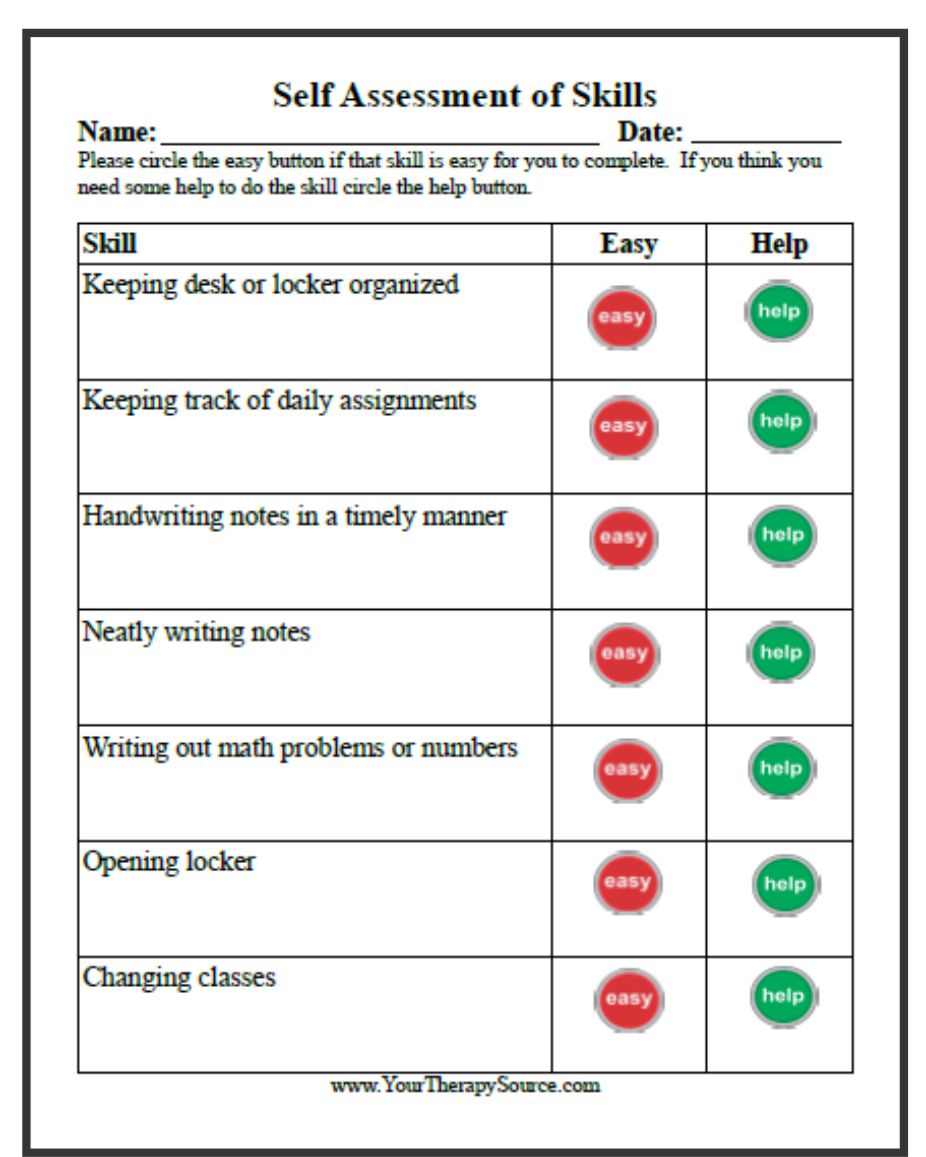
Free Self Assessment Form

Here is a free self assessment of skills form for students or clients.  You can type any skill into the form and the children can circle whether they think the skill is easy or they need help with the skill.  It will give you a general idea of the child's perspective of his/her skills.  Perhaps it will help you and the child identify areas of strengths and weakness.  Try having the child fill out the form at the start of the school year and then at the end of the school year.  Did his/her perceptions change?  

Go to YourTherapySource to get the download.

Thursday, August 22, 2013

Life Skill of the Month

Here is a new packet to download that includes 12 posters and 12 hand outs on life skills. 

The twelve life skills are: Oral Hygiene, Cleaning Your Room, Laundry, Personal Hygiene, Meal Preparation, Outdoor Chores, Shoe Tying, Kitchen Clean Up, Telephone Use, Table Setting, Dressing, and Shopping.

Hang up the poster in the class or therapy room and review the steps of that life skill.  There is a corresponding hand out to send home with tips and suggestions to help children learn that life skill for carry over at home.  Many schools have character traits of the month, how about life skill of the month?  ALL children will benefit from this activity.  You can get a free sample on meal preparation at YourTherapySource.com/lifeskills. 

Thursday, June 25, 2009

Website for Life Skills

This website, www.gcflearnfree.org/everydaylife/, offers interactive lessons for daily life skills such as cooking, banking, shopping, schedules and more. The lessons allow learners to practice life skills to be successful in everyday life. This is definitely worth a look for any occupational therapist especially those that work with older children and young adults. Best part...all free!
Related Posts Plugin for WordPress, Blogger...