Showing posts with label play time. Show all posts

Thursday, February 16, 2017

New Ways to Play Candyland Including Exergaming

New ways to play candyland

Playing board games with children offers learning opportunities to develop counting skills, color recognition, fine motor skills, self regulation and social skills.  Candyland is an all time classic.  It was created in 1948 by Eleanor Abbott, while she was recovering from polio and was tested by the children in the polio wards in the hospital.  The game was submitted to Milton Bradley and the rest is history!  Children seem to love this game and will play it over, over, over and over again……  You get it.  It gets a bit boring after awhile.  Here are new ideas to change up Candyland:

Use the cards only –  Use the cards for a scavenger hunt.  Turn over one card.  See if the child can race to touch an object in the room that is the same color.  Hide some of the cards around the room, gym or playground.  How quickly can the child find all the blue cards, all the red cards, etc?  Add in handwriting practice.  Turn a color card over.  Write a sentence with that color word in it.  Turn over three cards.  Write a sentence with all three color words included.  Make a category game.  Turn over a random color card.  Write down as many items as you can that are that color.

Adapt the board game to add a tactile component for children with visual impairments.  Read about how to do it at Paths to Literacy – Adapting Candyland for Players Who are Blind or Deaf Blind.

Add in exercise and physical activity – some “exergaming”.  Candy Game Exercises sneaks in some exercises and physical activity while practicing turn taking, color identification and visual perceptual skills. This download includes 30 exercise cards, 30 regular color cards and the special cards (6 for the older version and 7 for the new version). Use these cards instead of the traditional color cards that come with the Candy Land® game.  If you don’t have Candy Land®, there is a Candy Trail game included that you can print and use with the cards.  Find out more information.

Candy Game Exercises


Reference: National Toy Hall of Fame.  Candyland. Retrieved at http://ift.tt/2kVQ3oS on 2/16/17.

The post New Ways to Play Candyland Including Exergaming appeared first on Your Therapy Source.

Sunday, September 25, 2016

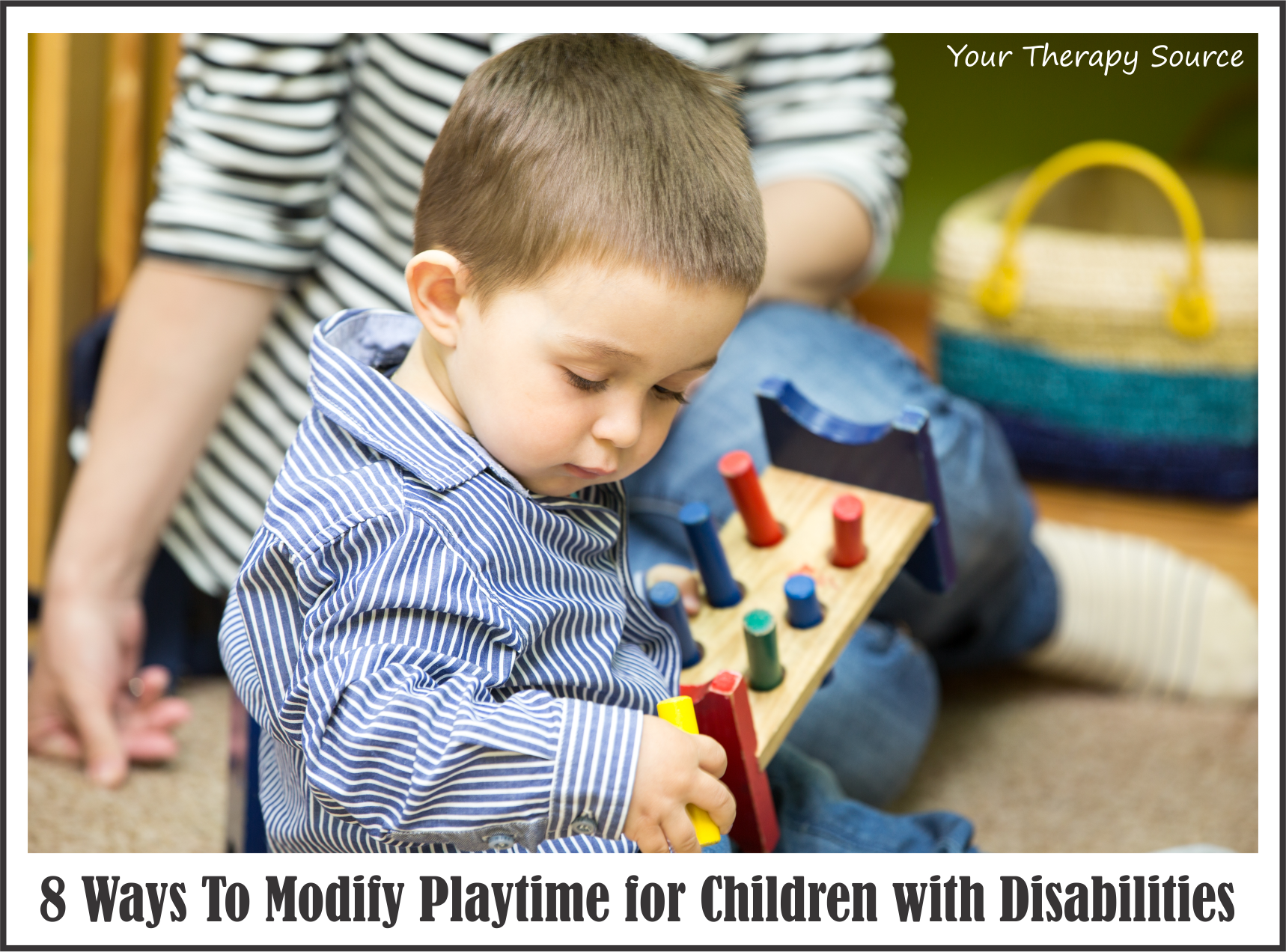
8 Playtime Modifications for Children with Disabilities

8-ways-to-modify-playtime-for-children-with-disabilities

Whether it be at home, daycare, school or extracurricular activities, children with disabilities may benefit from modifications during playtime. Here are 8 questions to ask when assessing a child’s needs during playtime:

  1. Does the environment need to be modified? If the physical environment is adapted perhaps the child will be able to be more independent during playtime. For example, move toys down to lower shelves to allow the child to access the toy without asking for help.
  2. Do the play materials need to be adapted? For example, build up a handle on a toy so a child can grasp it independently or use a larger ball so a child can catch it.
  3. Do you need to make the activity easier? For example, change the rules of the game to shorten the length of time to play or simplify the steps of a game.
  4. Do you need to make the play time more motivating for the child? Perhaps the child is not engaging in play because he/she is not interested in the toy or activity. Try using what a child enjoys playing with in different situations to expand his/her repertoire of play.
  5. Do you need to provide adaptive equipment? For example, use a chair with more support to provide additional postural control so the child can use his/her arms and hands more efficiently.
  6. Do you need to provide prompts to encourage appropriate play? Try modeling the activity or providing occasional verbal prompts for suggested uses of the toys.
  7. Do you need to partner the child with a friend? Try teaming the child up with a friend to model play activities or turn taking to complete a game.
  8. Do you need to provide step by step visual directions? Try placing visual step by step photographs in the play area for reminders of suggested play activities.

Play - Move - Develop

Play Move Develop is a collection of 100 reproducible sensory motor activities to encourage motor skill development and learning.  Find out more information.

Reference: Sandall, S. Play Modifications for Children with Disabilities. Young Children Journal. Retrieved from the web on 9/23/16 at http://ift.tt/2cSPo34

Read more on Gross Motor Skills and the Development of Play here.

The post 8 Playtime Modifications for Children with Disabilities appeared first on Your Therapy Source.
Monday, December 26, 2011

Playing with Children


During this time of year, children usually have many new toys and gadgets to play with. Parents can play a supportive role in encouraging play skills and get in some fun bonding time. Here are several tips when playing with children:
1. Turn off all cell phones, televisions and computers while you are playing with your child. Set a good example by ignoring your electronic devices while you play.
2. Follow the child's lead. Let the child decide what to play with. If the child is playing pretend play along and follow their directions.
3. Play at the child's level. If the child is playing on the floor, get down on the floor to play with him or her.
4. Do not have a plan. This is the hardest to follow. With all the routine and rushing in today's lives, it is very hard as a parent not to have a plan. Just sit and play even if it is just for a few mintues. The child will appreciate your undivided attention.
You can print out this flyer to hang up in your playroom to remind parents how to "behave" during playtime.
Related Posts Plugin for WordPress, Blogger...