Showing posts with label school based physical therapy. Show all posts

Friday, January 5, 2018

Providing Related Services to Homebound Students Survey Results

Providing Related Services to Homebound StudentsProviding Related Services to Homebound Students Survey Results

During the last quarter of 2017, Your Therapy Source posted a survey on providing related services to homebound students.  A school-based therapist submitted a question regarding how other districts were providing related services to students who remain at home, therefore a survey was created to see how other districts service homebound students.  It was requested to only answer the survey if you are a related service provider working in a school district (preschool or K-12). The survey received 238 responses.

Results of Providing Related Services to Homebound Students Survey:

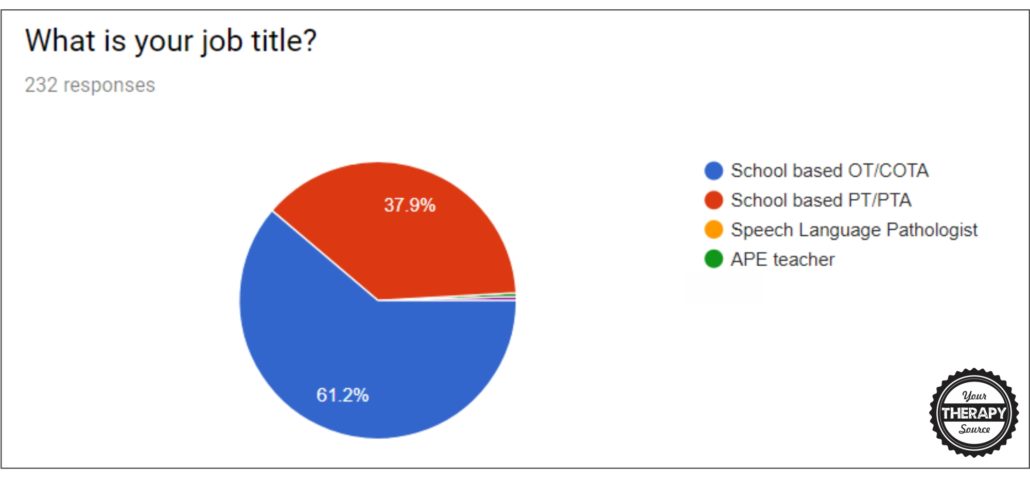
Question 1:  What is your job title?

  • 61.2% were OT/COTAs
  • 37.9% were PT/PTAs
  • the remaining responders were 1 SLP and 1 APE teacher
Providing Related Services to Homebound Students

Question #2: Do the majority of your school district’s homebound students receive physical, occupational or speech therapy as direct or consult services?

  • 54% received direct services
  • 30.2% received consult services
  • 3% do not provide services to homebound students

Do the majority of your school district's homebound students receive physical, occupational or speech therapy as direct or consult services?

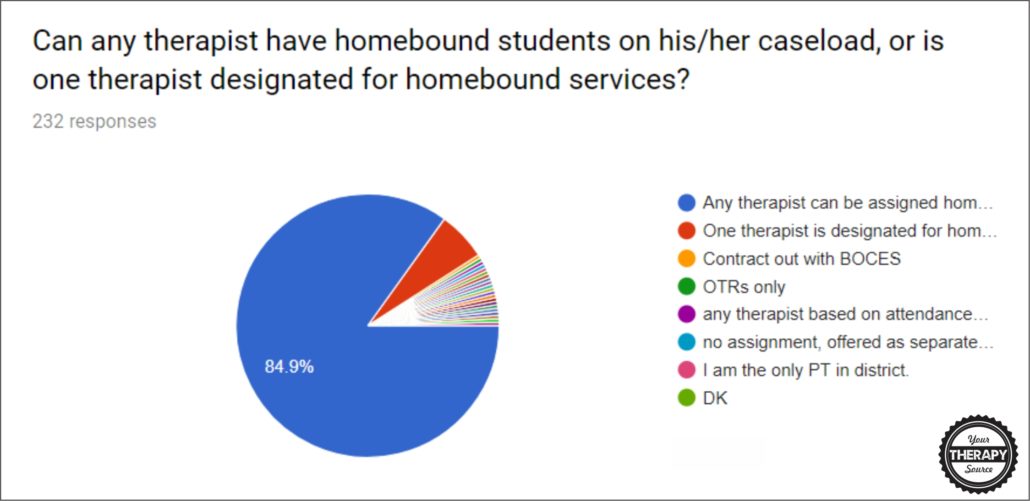
Question #4:  Can any therapist have homebound students on his/her caseload, or is one therapist designated for homebound services?

  • 84.9% any therapist
  • 6% one therapist is designated

Can any therapist have homebound students on his/her caseload, or is one therapist designated for homebound services?

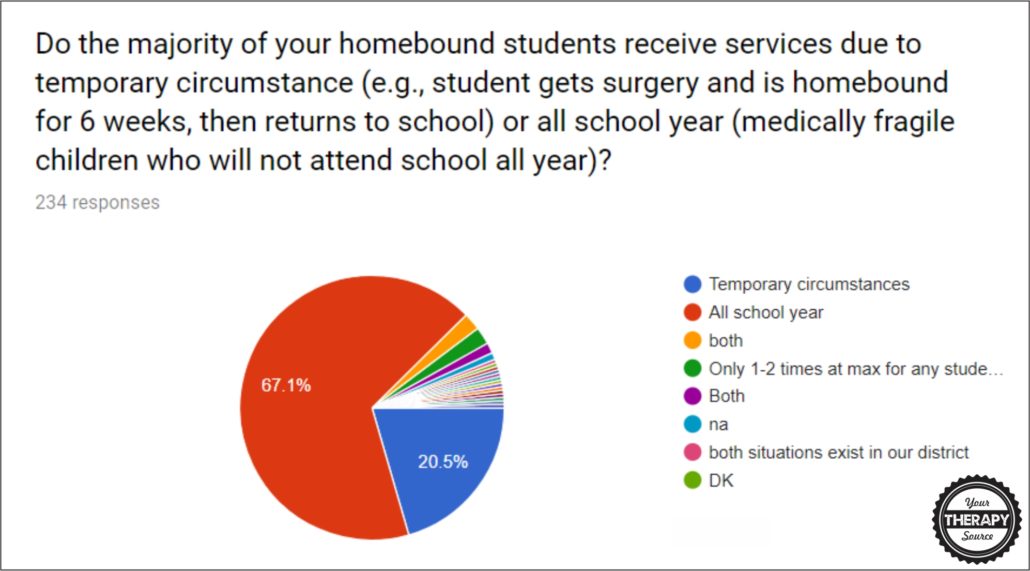
Question #5:  Do the majority of your homebound students receive services due to temporary circumstance (e.g., student gets surgery and is homebound for 6 weeks, then returns to school) or all school year (medically fragile children who will not attend school all year)?

  • 67.1% homebound students receive related services all school year
  • 20.5% are temporary circumstances

Do the majority of your homebound students receive services due to temporary circumstance (e.g., student gets surgery and is homebound for 6 weeks, then returns to school) or all school year (medically fragile children who will not attend school all year)?

Question #6:  Does your school district have a formal policy regarding related services for homebound students?

  • 28.2% do have a formal policy regarding related services for homebound students
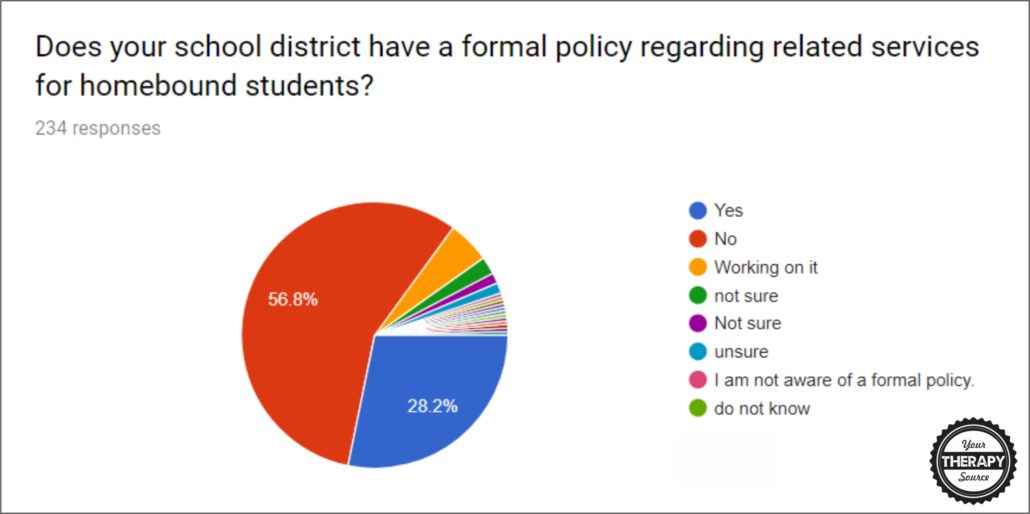
  • 56.8% do not have a formal policy regarding related services for homebound students

Does your school district have a formal policy regarding related services for homebound students?

Question #7:  As a related service provider, what would you change about your school’s practices regarding providing related services to homebound students?

Short Answer Responses:

  • Nothing (11)
  • consistency (2)
  • hire outside contractor to complete these services
  • Better define the need for homebound status and have one therapist cover the district instead of different therapists.
  • Increased parent and homebound special education teacher knowledge
  • Have the student come to public place if medically possible vs. therapist in homes.
  • I don’t think there is really anything to change. We typically go out with the teacher and provide support in the area of seating and positioning and/or mobility, typically an hour a month. So far that has worked well.
  • I would have a policy in place for therapists to refer to.
  • Decrease the reliance on related services without having adequate academic tutoring in place.
  • if provided at home needs to be in an effort to relate services to school so that the student can return to school unless the child is medically fragile
  • I currently do not have a homebound student. I think criteria for services needs to be clearly stated in a related service policy
  • Need to concentrate the number of IEP goals for homebound students and who will implement them.
  • OT is related in the school setting. I find that a medical model service is provided in homebound more than accommodations, etc. that might take place in a school setting.
  • A policy regarding related services and homebound children is a good idea.
  • I would like to see therapists allowed to see the student after the school day and be paid hourly for that service. It is too hard to fit homebound students into an already tight schedule, especially if the service is only going to be temporary.
  • There is no one option. Each case is handled individually.
  • I would change our practice from direct services (1 or 2x week) to consultation in the home, as many times the student is either too sick for therapies or isn’t motivated to work.
  • I would prefer more communication among therapists. This doesn’t happen at all.
  • I would formulate a policy about service time and expectations so that they were consistent for all homebound students
  • Allow therapist adequate time to add homebound kids to their schedule.
  • Have a clear procedure and maybe even a specific team designated to do so
  • have a formal policy and more communication with homebound teacher and family about how to hel the student more while homebound.
  • Increased communication between parents and staff members as well as clearer guidelines in determining when to put students to home bound status
  • remembering to include in IEP meetings
  • I would make any homebound student PT consult only.
  • compensation should be higher
  • improve the efficiency of the process, takes too long to get homebound started
  • the teachers who service the homebound students go after school hours for extra pay. Related service providers must go during the school day. It is very difficult to work together.
  • Need more formal policies in place, including criteria for discharge/change in service delivery (consult).
  • having a policy- reassessing the situation as caseloads change to see if the service would be better outsourced
  • The students on homebound have Dr. orders they are medically fragile because the parents wanted it for their children but they would be MUCH BETTER in school with a day full of sensory stimulation and interaction with other students.
  • Currently, I only have one on my caseload and she is often too ill for therapies. It is working the way we do it right now.
  • our homebound department is totally contracted to teachers after the school day, and most of them are general education teachers, who have no background in working with special needs, cognitively impaired, medically fragile students. Because the teachers are not there until after contracted time, it makes it difficult to interact with them. I would reinstitute teaching positions for these students. The 3-5 year old students do receive services within the school day.
  • I think the way we do it works. We assess students and determine if educationally related services are needed based on the student’s needs and what the teacher will be responsible for.
  • Some homes/neighborhoods are not safe. It would be great to have a central location for therapy, but there are many variables for this to be successful.
  • Would like them to have a set policy rather than set it individually, often based on pushiness of parents and not necessarily on needs of the students
  • That the student would have to try to come to school on a shortened day/week after a year of homebound. Most of the homebound students are not that medically fragile and are going on outings with their parents when they are home during the day.
  • To have a policy regarding the necessity of school-based related services as part of the homebound instruction. Specifically, how does homebound school-based PT look different than home-care PT services?
  • We should not be expected to go into homes that are not safe or are extremely unclean. Our district should come up with another option in those special circumstances.
  • There needs to be a clear description and explanation to parents of school-based vs habilitative services.
  • I feel that services should be monthly/yearly and primarily consultative because we usually end up delivering services that are more clinically based.
  • We have a small percentage of students that receive related services on Homebound.
  • We rarely have students that are served in this capacity and usually if they are it is medically fragile children. I do hate that sometimes kids wind up on homebound due to limited communication between doctors and school. In those cases, I wish the doctors would come to meetings or participate by phone.
  • No changes, they are a very minimal part of our caseload.
  • More consult, less direct. The 2 medically fragile homebound students on my caseload have full-time nurses that know more about them than I ever will. I am not providing skilled service. It is mostly passive range of motion for maintenance which can be taught to caregivers.
  • would like to have a formal policy in writing
  • Provide more equipment
  • Develop consistent guidelines for service type and frequency, discuss equipment, discuss goals, discuss how to best be integrated with teachers versus being more of a medical model
  • More defined policy for determining homebound related service provision
  • better communication between staff and families on plan of care and progress monitoring
  • Should be consultative when going homebound.
  • written policy
  • Making sure that the IEP is educationally relevant instead of therapy oriented even though the student is receiving services at home.
  • Nothing. We take it case by case. We have a general policy, but it can change based on the needs of the student.
  • a clearer delineation between medical and educational OT services
  • Make more clear-cut guidelines
  • Would like more autonomy with goals to reflect the unique needs of a homebound student’s learning needs in their home environment.
  • Protocol for frequency of homebound PT services
  • Follow the same policy as we have for students who attend school – educational relevance and impact.
  • clear guidelines on medical vs. school model
  • To have designated therapists service homebound students versus homeschool therapists servicing them, particularly year round.
  • have more materials provided
  • Teaching staff pay increase. We have many related service providers but not enough teachers for homebound students.
  • I think because it is so specific to each student, it works out fairly well. Only issue is sometimes being available so student with primary teacher (ex. if they provide services after school hours).
  • When homebound is not for a medical reason but more of a parent preference, district does not push the issue of coming to school
  • To not let parents dictate what the student needs, but to let the team as a whole determine what is necessary for the student to benefit from their special education curriculum
  • It seems a consultation model would be more appropriate
  • They are great using parapros for a monthly home visit instead of sending out professionals for educational tasks
  • Improve communication.
  • make related services times correlate with instructional time i.e. not give 1 hour of OT if only getting 5 of instruction.
  • Have a formal policy regarding related services for homebound students
  • district therapists provide services, not contracted therapists
  • If the number of homebound students receiving Services Exceed 2, look at the viability of having another therapist provide services for any additional children
  • We do have some issues with wanting two staff to go into the home for safety/legal reasons and this is not always approved by administration.
  • Add more hours to our schedule to complete homebound services, since it involves more time (driving there and back and the actual service hours) and we both work part time.
  • services must be related to the current educational setting. IE home. If the child is able to navigate home environment then PT should be very limited or consult only.
  • Improving correlation between homebound therapy and the educational demands as a homebound student.
  • if they are medically fragile or unable to attend school then the school-based OT or PT should not be servicing them.
  • More consistency in the provision of services
  • Have a specific Homebound PT providing the services
  • I would like more safety procedures. The school has no idea when or where I go. In today’s world going some places are not safe. It’s also hard when you have a full school day and then go to someone’s house after work hours.
  • I am ok with how we do it in my district. I am allowed flexibility to set my schedule and adapt service minutes to best serve the student.
  • Our district is doing a good job with it
  • Difficulty in scheduling, need to know when school starts
  • Clarify policy
  • Speed up the process.
  • I don’t believe it is appropriate to treat homebound kiddos if the therapist is a school therapist. It should be medically based therapies only. When the kiddo can tolerate school days, then he should get school-based therapy services. We really need to keep the lines clearer.
  • We discuss on a case by case basis and I am happy with that
  • Make a policy on the appropriateness of serving these students and knowing when to dismiss them from services. Also, educate families and staff on medical vs educational relevance for medically fragile students.
  • I think we need a formal policy regarding related services for homebound for medically fragile students that may receive services year long.
  • Allow enough time or allow the therapist to do visit after school at contractor’s rate.
  • More consistency as to who is eligible.
  • It should be more consultative than direct and not just mirror what they would get in a traditional educational setting.

ANSWER OUR CURRENT SURVEY QUESTION

If you need forms and templates to increase communication between school and home check out, School and Home Communication Forms for Therapists.

Therapists, school staff, and parents are all so busy it can be hard to communicate. This collection of forms will save you loads of time. Therapists can review schedules, report on daily or weekly progress, track behavior, review IEP goals, track communication and more. It is suitable for all school-based therapists. Parents can request therapist to complete daily or weekly updates especially beneficial for non-verbal children.  FIND OUT MORE.

Providing Related Services to Homebound Students


The post Providing Related Services to Homebound Students Survey Results appeared first on Your Therapy Source.

Friday, December 29, 2017

Never Have I Ever Therapist Style

Never Have I Ever Therapist Style from Your Therapy Source

Never Have I Ever Therapist Style

I keep seeing all these point scales all over Facebook where you give yourself a score based on things that you have done.  I thought it would e fun to create a Never Have I Ever Therapist Style.  Give yourself one point for each statement that you have done during your career.  Here is my hypothesis – any pediatric therapist who gets a perfect score of 20 probably has at least 5 years of school-based therapy experience.  Would love to hear if you prove me wrong!

So here we go – one point for each statement, Never Have I Ever…

___ been locked out of a school
___ worked in a closet
___ unable to discharge because IEP team refused
___ been barfed on
___ worked with demanding parents
___ spent too much time in the toy aisle
___ repeatedly heard “fix this sensory issue”
___ had a ridiculously messy car
___ had my own kids take my work toys
___ ripped holes in the knees of my pants
___ disagreed with a lawyer
___ just finished scheduling caseload then student transfers in
___ written IEPs at home
___ completed and typed up an eval in under 2 hours
___ hurt your back on the job
___ stayed on schedule all day
___ provided carry over activities that no one followed through with
___ been called the OT/PT
___ cringed at the statement “babies don’t need to crawl”
___ fought to stop taking away recess as a punishment

TOTAL SCORE: ????

In all seriousness, the job of a school-based therapist can be overwhelming at times, to say the least.  At the end of the day, it is an amazing job where we get to work and play all day long.  As pediatric Occupational and Physical Therapist, we always need to remember that one of the most important, if not the MOST important, aspect of our job is to educate.  We need to let students, teachers, school staff and parents know what we do and why we do it.  Without buy-in from all team members, goals can not be reached.  In addition, in order for therapeutic activities to be carried out all day long we need to educate people how to make that happen.

Read more:

5 Reasons to Provide Hand Outs

How to Be a Successful Pediatric Therapist Coach

Educate Poster

The post Never Have I Ever Therapist Style appeared first on Your Therapy Source.

Thursday, August 17, 2017

Meet the Therapist Letter Freebie for Back to School

Meet the Therapist LetterMeet the Therapist Letter Freebie for Back to School

Back to school is upon and one of the most important jobs of a school based therapist is to keep open lines of communication with teachers, staff, and parents.  Complete this FREE Meet the Therapist Letter for Back to School to start the year off right (free download at end of post).

Parents may encounter new teachers, staff, and therapists from school year to school year which can be difficult. School staff, parents and school based therapists can help to forge stronger relationships by communicating with each other.  This can be the key to a student’s success if everyone is on the same page.

The Meet the Therapist Letter can be edited in Google Slides or Powerpoint (or just print as a PDF and hand write in the boxes).  You are not able to edit the basic layout, but you can edit each text box.  You can change the job title to anything in Google Slides or Powerpoint i.e. OT, PT, COTA, PTA, Speech Language Pathologist, Teacher, etc.

This letter helps to provide information about you, your education, experience and contact information.  View the sample Meet the PT letter.

Meet the Physical Therapist Letter

When you download the freebie, be sure to edit the one page or start fresh by just typing into the text boxes.

If you want more forms and templates to increase communication between school and home check out, School and Home Communication Forms for Therapists.

Therapists, school staff, and parents are all so busy it can be hard to communicate. This collection of forms will save you loads of time. Therapists can review schedules, report on daily or weekly progress, track behavior, review IEP goals, track communication and more. It is suitable for all school based therapists. Parents can request therapist to complete daily or weekly updates especially beneficial for non-verbal children.  There are 21 forms including:

  • Therapy Schedule
  • Therapy Update 1
  • Therapy Update 2
  • Therapy Notes
  • Behavior Form
  • Teacher Communication Log
  • Parent/Guardian Communication Log
  • Weekly Log
  • Daily Log
  • Great News
  • Letter of Concern
  • Getting to Know You
  • Pre-IEP Input
  • Goal Review with Student
  • Goal Review for Teachers
  • Goal Review for Parent/Guardian
  • Therapy Lesson Plan
  • Communication Checklist
  • Therapy Survey for Kids
  • Therapy Satisfaction Survey for Parents/Guardians
  • Therapy Satisfaction Survey for Teachers

Find out more about School and Home Communication Forms for Therapists.

Read 5 Steps to Increase Communication this School Year.

To download your FREE Meet the Therapist Letter sign up to receive our email newsletter and you will be redirected to the zip file.  If you are already a subscriber just enter your email and you the download will start.

Meet the Therapist Letter

The post Meet the Therapist Letter Freebie for Back to School appeared first on Your Therapy Source.

Sunday, August 6, 2017

Do School Based Therapists Work Over the Summer?

Do School Based Therapists Work Over the Summer

Do school based therapists work over the summer?

Many times school based therapists are asked if they work over the summer.  For the past few months, the Your Therapy Source survey asked this question.  One of the reasons was to determine a general idea of whether school based occupational or physical therapists work over the summer.  Another reason was to find out if they work in schools or where else they may work over the summer.  When you are done reading please answer the current survey.

The results have been tallied after 258 responses to the question do school based therapists work over the summer:

Question #1:  What is your job title?

Question #2- Do you work over the summer at your school or elsewhere?

Question #3 – If yes and you work at your school, approximately what percentage of your caseload receives therapy for 12 months?

Question #4: If yes, but you work somewhere else over the summer, what do you do? (ie geriatrics, private pay, home care, waitress, tutoring etc.)

Responses:

Below are the short answers that survey participants provided.  It is amazing the variety and skill set that everyone has.  It is very impressive!

geriatrics (5)
private pay (2)
sensory gym (2)
Cover another small school district as well
Private practice Pediatric PT clinic
Pedi outpatient
SNF
Summer residential camp and day camps
Swing bed & skilled nursing home
I work at my primary school setting
Geriatric LTC and home services
My job includes early intervention as well as school based related services. Our EI program is year round.
work PRN home care
PRN at local hospital
OT for a home care agency and docent at local small museum
Private practice Peds
Acute care hospital
acute care in a hospital
Retail, small business, shoes
private clinic
Pre-school, PCA, Housekeeping, Drive farm trucks
Private pediatric clinic
Church Childcare
Outpatient pediatric clinic
geriatrics and some outpatient peds
Developmental centers
Hippotherapy
Still in Early intervention as the center based program is year round.
I work for my school district and also cover for per diem at a skilled nursing facility
State funded Early Intervention home visits)
ECI
pediatric therapy clinic and private pay
work at a charter school/outpatient psych program for kids with mental illness and autism
Summer groups (pediatric clinic), home health pediatric
private practice pediatrics
Early intervention Peds
outpatient psych
B-3 Services; PRN work in LTC, Hosp. Inatient/Outpatient, or Home Health
Special Care Nursery (Level 1B)
extended school year for the cooperative (pediatrics)
0-3 Early Intervention
I also do peds home care in the summer
rehab
adult day health center
I work for a BOCES Extended School Year program. School age children who require an educational program to prevent regression.
pediatric outpatient in a clinic
outpatient pediatric therapy clinic; early intervention
Early Intervention (birth to 3 y/o)
I work in our office, creating programs, and inservices and at any of the schools as needed.
I also work pediatric out patients
Summer Program for regular ed children doing movement activities to supplement academic programs.
I work a small amount out my school in the summer and primarily work in a rural hospital/nursing home/outpatient clinic.
teach summer school and private tutoring
Charity in Cameroon Africa teaching about Sensory and motor play for a new school ministry for Autistic kids.
Home health
acute care in hospital
home care
clinic and home health
early intervention
Work in different schools and Infant and Toddlers.
Basic home care
Private clinic
I worked summer camp positions in arts and crafts until recently
Early Intervention & Private cases
pediatric acute care, consultation for children’s services
I co-coordinate an intensive needs summer program at our school. We have lots of fun. I have been doing this every summer for 7 years now.
On-call at skilled nursing facility
Geriatrics
Home health
PRN skilled nursing
Also work at an additional school that is not my usual caseload for six weeks
Quality time with my children
PRN SNF
Diagnostics for early childhood
Other therapists can sub positions so IEP’s are met.
Work in my current school district.
Summer program runs for only 4 weeks.
also work in a short term rehab/LTC facilicy
respite care in the summer, PRN at a SNF 2 hours from my home, and worked at a frozen yogurt place.
Home Health
hospital and inpatient rehab
geriatrics – skilled nursing facilities
early intervention (0-3 years) for different agency
Answer our current survey.
Do school based therapists work over the summer


The post Do School Based Therapists Work Over the Summer? appeared first on Your Therapy Source.

Tuesday, May 9, 2017

What Have You Learned From Other School Staff?

What have you learned from other school staff this year?  As school based occupational and physical therapists, we can learn so much from teachers, teacher assistants, administrators, school nurses, school counselors and other staff members.  We may know lots of information on fine motor skills, gross motor skills, visual perceptual skills, sensory processing and coordination but we are lacking in many other educational traits.  Throughout the school year we may hop in and out of classroom seeing snippets of what goes on during a child’s day.   Watch, observe and learn from all school staff.  Attend all of your students’ IEP meetings if able.  To hear all of the team members’ perspective on a student is invaluable.  Here are what I consider the top 5 things school based therapists can learn from other school staff:

1. Use a plan book. Teachers are required to have their lessons planned in advance. Therapists should try this idea. I plan for the next session for a student(s) the week or night before but I do not always write it down.  Read here for 5 reasons to use a Therapy Planner this year.

2. Group management. Teachers are amazing at managing large groups.  Gym teachers are the best!  Have you seen some of them in action with sometimes two huge classes at one time?  They are organized and routinized for sure!   Therapists frequently only have 1 student at a time. Watch and observe how teachers manage large classrooms. If they can manage 25 students at a time we can certainly manage small therapy groups.  Read here for some tips on managing group therapy sessions.

3. Recording grades and data collection. Obviously we do not have to grade assignments but checking annual goals more often than on a quarterly basis is important. Teachers record grades and correct homework to make sure a student is progressing satisfactorily. Make sure your therapy students are progressing towards their annual goals in a timely manner by checking those goals at least biweekly and using progress monitoring tools (check out Progress Monitoring Forms for Fine Motor and Gross Motor Skills) .  Administrators LOVE data collection.  Ask them questions if you need advice on how to get started or improve your current methods of data collection.  They are trained very well in data collection.  Show them how your services help students to succeed.

Data Tracking Forms for School Based Occupational and Physical Therapy

4. Progress Reports and Report Cards. Teachers will frequently send home progress reports if a student is not performing as well as can be expected. If a student is not making satisfactory progress towards his/her therapy goals do you let the parents know before the quarterly reports come home?  Communication is key!

5. Have a back up plan. Do you ever notice that good teachers and teacher assistants seem to always have a back up plan? If the class unexpectedly finished an assignment early they always have an extra activity planned and ready to go. Sometimes it is a traditional fun game or it is the next assignment. Therapists should have back up activity ideas if a student reaches the goal quickly, loses interest or fatigues.

What is your favorite lesson you learned from a teacher?

The post What Have You Learned From Other School Staff? appeared first on Your Therapy Source.

Sunday, May 7, 2017

5 Multi-Purpose, Lightweight Items for Your Therapy Bag

A day on the life of a traveling school based therapist goes something like this.  Pack up a bag at home of equipment and tools  (i.e. toys, games, paper and activities) that you will need for your therapy sessions.  Some of the equipment may not be easy to carry since many therapy sessions incorporate gross motor, fine motor and sensory activities.  Load it into your car.

Stop at school number 1 and get everything out of your car, equipment and paperwork requirements.  Carry all of your stuff to the school door.  Get buzzed in or use your card to unlock the door.

You rush into your therapy room, classroom or hallway carrying all your equipment.  The therapy session begins and you grab a few things out of your bag if needed.  Document the session and on to the next student(s).

Pack everything up, lug it back out to your car and you head to the next school only to go through the entire routine again of carrying stuff into the school.

Or maybe you are one of the lucky school based therapists who have one school and perhaps even an office or therapy room.  Regardless, having some lightweight items that you can carry that are versatile is a must.  Here are 5 items that are lightweight, easy to transport and can be used for a variety of activities:

  1. Painter’s Tape – You can do so many things with a roll of painter’s tape.  Set up obstacle courses.  Use on the wall to throw a ball at a target.  Here is a previous post on 5 gross motor activities to do with painter’s tape.
  2. Plastic Cups – Use as targets, stack them, kick them, throw a ball at them, jump over them, turn them over, transfer objects into them, etc.
  3. Balloons – Use for various gross motor games, eye hand coordination activities, balance activities and more.  If your school does not allow balloons, then toss a beach ball in your bag.
  4. Ebooks on the iPad – Save Your Therapy Source books directly to your iPad.  Use for reference for activity ideas that require no equipment.  Use an app that you mark up pdf’s on your iPad.  You can find free or paid apps that allow you to mark and draw on the iPad with pdf documents. Therefore, if you have ordered some of our visual motor electronic books you can now store them on your iPad and have the children practice visual motor skills using the iPad instead of paper.
  5. Exercise cards or Yoga Poses – Laminate the small cards and you have a great selection of gross motor and strengthening activities that take up very little space in your therapy bag.  Check out Yoga Poses, Core Strengthening Exercise Program, Physical Activity Cards and Games, Classroom Activity Posters or 25 Bilateral Coordination Activities.

What is your favorite multi-purpose, lightweight item to toss in your therapy bag?


The post 5 Multi-Purpose, Lightweight Items for Your Therapy Bag appeared first on Your Therapy Source.

Wednesday, March 1, 2017

7 Simple Tips to Help Students Process Sensory Information

7 Simple Tips to Help Students Process Sensory Information

Have you ever been in a classroom as an adult?  Wow, they can be chaotic, loud and overwhelming for anyone.  The days of students sitting in the desks quietly working are over.  Cooperative learning, alternative seating arrangements and group projects have turned the classroom environment upside down.  On one hand it is a constant learning environment, all the other hand it can increase the chances of sensory overload for any student.  Students need to process all the sensory information that bombards them throughout the school day – sights, sounds, smells, tastes, touch and movement.  Here are 7 simple tips to help students process sensory information in the classroom:

Keep consistent.  Establish a structured routine throughout the school day so students know what to expect.  Provide visual schedules if necessary.

Maintain the classroom furniture arranged the same way.  When the classroom stays the same, this also helps students to know what to expect.  Their bodies learn what they need to move around, over and in between to transition in the classroom.  For alternative seating classrooms, try keeping at least the tables and carpet areas in the same position and you can move the various seats.

Keep student apprised of upcoming transitions.   For example, give students a heads up of what is coming next and/or how much time is left for the current activity i.e. “We will be going to art in 5 minutes”.

Provide student with frequent movement breaks.   Our bodies are not designed to sit all day.  Keeping students active also helps to activate the brain.  Incorporate movement with learning, assign students jobs that require physical activity, increase recess time and add in brain breaks.

Promote cooperative learning.  Do group assignments so students can learn from peer role models.

Encourage a multi-sensory approach to learning.  Learning styles can affect a students ability to process sensory information.  Try to create lessons plans that are multi-sensory i.e. tactile, visual, auditory and kinesthetic (movement).

Provide the student with choices.  Everyone has sensory preferences.  If someone has a very strong sensory preference, it can possibly interfere with his/her ability to learn.   If possible, allow the students to make their own choices i.e. fingerpaint or paintbrushes, stand up or sit down, pencil or pen, etc.

What suggestions or tips have you found to help students process sensory information at school?

Typical Classroom Sensory-Based Problem Behaviors & Suggested Therapeutic Interventions

Typical Classroom Sensory-Based Problem Behaviors and Suggested Therapeutic Interventions

This book offers many suggestions for therapeutic interventions for 12 different problem behavior categories.

The classroom sensory based problem behaviors include the following:

  1. Sitting/Poor Work Tolerance
  2. Vision/Attention Related
  3. Oral/Facial Related
  4. Visual Sensitivities
  5. Tactile/Proprioceptive/Personal Space Issues
  6. Self-Injurious Behaviors
  7. Gut Reactions Due to Perceived Stress/Anxiety
  8. Difficulty Staying with the Group
  9. Delayed Immature/Inefficient Grasp Pattern
  10. Visual/Proprioceptive Sensory Seeking Wrist/ Hands
  11. Difficulty with Positioning/ Lower Extremity Awareness
  12. Oral Motor/ Self-Feeding Issues

Under each problem behavior category the book lists:

  • what the child may be displaying
  • possible underlying causes
  • sensory strategy solutions

FIND OUT MORE.

The post 7 Simple Tips to Help Students Process Sensory Information appeared first on Your Therapy Source.

Tuesday, January 31, 2017

Groundhog Day Visual & Gross Motor Challenge

Groundhog Day Motor Minute from Your Therapy Source

Take the Groundhog Day Motor Minute Challenge.  Can you complete all the visual motor and gross motor tasks on this page in under two minutes?  This is quick, NO PREP, warm up activity, brain break, indoor recess or boredom buster for Groundhog Day.  And it is FREE! Woohoo!  We all love free.

If you like this activity check out the Motor Minute Challenges for any day of the week. Motor Minute Challenges is an electronic book of 20 sheets to complete that encourage fine motor, visual motor and gross motor skills. Complete each challenge sheet by finishing pictures, mazes, physical activities and more. Time the tasks for 1-3 minutes or let the child complete each one at his/her own pace. These pages are great for challenges at home, indoor recess time, rainy day activities and push in or pull out therapy sessions.   Find out more.

DOWNLOAD the Groundhog Day Motor Minute Challenge

The post Groundhog Day Visual & Gross Motor Challenge appeared first on Your Therapy Source.

Wednesday, January 11, 2017

Working Conditions Survey Results for School Based Therapists

working-conditions-survey-results-for-school-based-therapists

The working conditions survey results for school based therapists have been summarized.  As you can see from the results, there were 431 responses the questions about working conditions.  Frankly, I was shocked that close to 79% of the school based therapists felt that a national organization should be formed to establish working condition standards ( caseload, sessions per day, ratio of direct treatment to consultation with teachers etc) to improve outcomes for students receiving OT, PT or speech.  Whether that comes to fruition or not, it seems obvious that therapists need some help or guidance.  You can view the results below.  Following the results are some of the comments that were added to the survey.  Perhaps these results will help motivate additional research on the topic helping to make positive change.  Please take a moment to answer the current survey on handwriting and keyboarding.

Working Conditions Survey Results for School Based Therapists

Here are some additional comments that were added to the survey.  They provide a nice overview and what therapists might experience and some pros/cons for the idea of guidelines:

  • National standards would be nice. I live in a state that has very little school based representation, standards or guidance at the state level.
  • There needs to be a caseload limit. And when the limit is reached the therapist can be expected to look at discharges and if no discharges can be made then additional services need to be contracted out!
  • All states/ districts vary as do students. I think we need to belong to AOTA,APTA and ASHA and communicate with stakeholders. It would be difficult to prove that more time for therapists improves outcome of students as therapist expertise and goals and experience is as variable as the students we work with.
  • I don’t feel there is a national approach as these things vary by state, county, and city. However, I think there is a standard that should and could be placed by AOTA. It likely already is, and I’m just ignorant of it at this point (just started working in schools). I didn’t know what to ask for, and I ended up in a mess with little time and poor accommodations to service students. I do not get the opportunity to do my full frequencies, and push-in is being promoted, but in many ways is not helpful to the actual OT-related items I’d love to do.
    I am the only OT servicing every student in three rural counties driving up to 75 minutes in one direction for one student. We are told it is the expectation as a salaried professional to complete your work at home.
  • State standards not National
  • Practice patterns and work expectations vary too much across the US to try to legislate working conditions. I review IEPs from other states and they are very different from state.
  • To make guidelines for workloads yes.
  • We need to have some sort of standard in order to incorporate all the factors that go into service provision. We used to have a formula that took into account number of schools, number of miles between schools and then number of service hours with number of students. Without a format, school divisions will continue to push for whatever the staff will bear!
  • I think to form established regulatory standards via a national/formal organization for school based therapist is an excellent and much needed idea!
  • I have been a school based PT for 24 years. Over that time, my methods of intervention have ‘evolved’ to encompass inclusion, embedding skills within the natural setting, etc. Unfortunately, our administration still equates IEP minutes with ‘that is all the time you spend with that child’ so therefore you should be able to see this many in this amount of time. Conversations around workload versus caseload are evolving, but in these badly funded school settings with a number crunching administrator, it is a difficult conversation. We desperately need supporting standards, etc to help us provide what we know is needed in order to address the needs of our students and their classrooms. Thank you for starting the conversation with this survey!
  • I have worked in many different school based settings, and I have found that each one is unique in it’s own way. The number if students that are appropriate depends on the types of students you have, and therefore cannot be assigned a random number to determine a caseload. That said, admin does need to understand the need for time for consult, research, observation etc and not look at the 1:1 contact with students only.
  • Group collaboration never hurts.
  • We need guidelines on our case-load size when working in the schools.
  • This could be provided at the state- or county-level rather than nationally.
  • A national organization would be great, but each student receives such individualized service that it would be difficult to establish working conditions that were uniform across the nation. Some areas favor direct pull-out therapy some favor favor push-in therapy of more consultative nature.
  • I feel like school based PT’s are such a small portion of the profession as a whole that we are often overlooked. It would be extremely helpful to have some national guidelines! I am currently overseeing a staff of 12 OT’s and PT’s in a school district so this would be helpful as an administrator as well.
  • This is already encompassed in AOTA or APTA. Not to mention that a group can suggest all they want but it is a long way to laws and financial support. The Feds have yet to fully fund their initiatives for Special Education of the 70’s.
  • I think there should be some sort of a cap on the amount of students on caseload for each occupational therapy practitioner.
  • Dedicated space to see students is a big problem!!
  • The wide variety of service provision across the country causes problems when children move and services change – it would be helpful if we could all be on the same page to determine when it comes to how, how much, where, when, etc for service delivery.
  • We are under teachers contract however do not benefit from all be fits such as allotted prep and planning time, scheduled lunch times, time for conferences. Traveling between multiple buildings sometimes takes lunch times as well.  Scheduling always presents issues…
  • A national organization would be very useful for research.
  • Regarding the last question, guidelines rather than standards might be better. Each child and each classroom environment is unique and we must have the flexibility to adapt.
  • There are currently no guidelines out there that indicate the workload vs caseload for all therapists. We are left to advocate for ourselves in a system that has been notorious for having small budgets. I am constantly performing work at home on my own time, spending money to buy supplies needed to provide services and constantly on the run!
  • Every caseload, just like every student, is unique. The ratio of consult to direct treatment changes with caseloads and from year to year depending on need. Sessions per day can also change depending on the needs of students, special events, length of sessions, etc. Caseloads change depending on needs and could be larger with lots of consult or smaller with lots of direct service.
  • Not sure if we need an actual national organization, but better support at the state level, backed by AOTA.
  • A set of standards to refer to would be helpful because many therapists are working singly in school districts. Also as contract therapists rather than employees we often have very little say the hours that a district is willing to pay for and often little job security.
  • I hesitated to answer the last question. I’m not sure that is the answer, but having standards to refer schools to would give more weight to my one opinion about the quality of services being offered.
  • I find that I am often asked to observe, informally assess, or provide suggestions for students that are not on my caseload. I am happy to do this, but find it takes my time away from planning intervention sessions with my students. I wish there was time carved into my schedule to assist my building in general, in addition to time for my students. I want to be able to do both effectively.
  • Each campus and organization too unique. Goal is to work together to provide services for kids.
  • Although I think collaboration of ideas is always great, the way this question is worded sounds more like someone wants to mandate the situation. Every school district, available staff and caseload is unique and continuously in fluctuation as students move in and out, making set requirements impossible to maintain.
  • Back in the 80’s some practitioners and I began the movement for more organization among school based practitioners. We were instrumental in getting guidelines for best practice written as well as professional development and fieldwork sites for training. I have been actively practicing as a school based OT for over 30 years, never have I witnessed a more greater need than ever for a a national organization to support us and would be willing to help!
  • SLP have a caseload max in the schools. I see their caseloads going down. Caseload standards would be beneficial to our students and to our profession.
  • I have been a school therapist for nearly 20 years and caseload/level of service has been a constant struggle. Nationwide recommendations or guidelines in this area would be extremely helpful.
  • As a school based PT for 20+ years, delivery of services has evolved significantly. When we talk to our administrators about our needs, it would help to have standards to refer to as they still want to tie services to the amount of time on the IEP.
    I am required to pay teachers union dues and benefit very little from those other than salary negotiation. Having our specific practices and related issues supported would be more appropriate.
  • I believe there should be guidelines from AOTA (APTA, ASHA, etc.) to set an appropriate caseload size- based on work load, not caseload. I have been in positions where I was over scheduled and didn’t have the time to provide adequate therapy to students, but the district was unwilling to help in any way. I do not believe in organizations, such as unions, to determine such standards.
  • I am willing to be part of that national organization.

Please take the time to fill out the current survey.

The post Working Conditions Survey Results for School Based Therapists appeared first on Your Therapy Source.

Sunday, December 18, 2016

5 Ways to Improve Productivity

5-ways-to-improve-productivity-for-pediatric-ots-and-pts

The schedules of pediatric occupational or physical therapists tend to be extremely busy.  If you work in the schools, you know how hard it is to complete all the daily tasks, follow your schedule and maintain focus throughout the work day.  After work hours, add bringing paperwork home or phone calls to parents and doctors not to mention managing your own home life.  With the digital age being in full swing, your attention and focus can be pulled in many different directions affecting overall productivity.  Here are 5 tips to help improve your productivity throughout the day as a pediatric therapist:

  1. Start the day with a simple mindfulness practice.  Whether it be to take a few deep breaths, pray or meditate for awhile upon waking up take some time to be calm.  Don’t roll over and grab your phone.
  2. Organize your day efficiently.  Your brain is most likely more clear and fresh in the morning.  Schedule complex tasks in the morning.  Move simple tasks to the afternoon whenever possible.  Stay organized throughout the day and maintain a clean work environment (this one is really difficult for me!).  You will be more productive if you are less distracted by a physical or digital mess around you.  Try to keep your physical work area clean which would include your therapy bag to carry all your supplies, your car and your paperwork.  Also, try to keep your digital work area clean.  Delete unnecessary emails, apps or files.  Reduce clutter as much as possible on your home screen.
  3. Schedule smaller team meetings when possible and delegate tasks.  Limit the number of people to attend group meetings.  This cuts down on some people just sitting there for extended periods of time being unproductive if their opinion if not needed.   When in a meeting, delegate one person to be directly responsible for each task to make it clear who needs to complete each action item.  For example, if you are meeting on implementing modified seating then assign specific tasks to each individual ie therapist provides the alternative seating equipment, student must be safe with alternative seating, teacher’s assistant collects simple data on whether the modified seating is increasing attention to task, teacher reports on improvements noted in academic abilities and therapist modifies alternative seating choices if necessary.
  4.  Create templates or forms for frequent communication or documentation.   By streamlining the paperwork process you will be more productive. Check out School and Home Communication Forms for Therapists – a download of 21 forms to increase communication between therapists, school staff, students and parents or Data Tracking Forms for School Based OTs and PTs – a download of 7 data collection forms for monitoring progress in occupational and physical therapy in the school setting
  5. Take your own brain break.  Allow for time to reflect throughout the day and at the end of the day.  What did you do right and what can you improve upon?

The post 5 Ways to Improve Productivity appeared first on Your Therapy Source.

Wednesday, December 14, 2016

Work Station, Positioning and Keyboarding Skills

work-station-positioning-and-keyboarding-skills

Young children and students continue to spend more and more time keyboarding for written expression.  Whether it be at home before children are school aged or sitting long hours typing away throughout a child’s educational career or even as adults, the work station must be set up efficiently to allow for proper positioning while keyboarding.

Prior to evaluating keyboarding positioning skills check to ensure the work station is set up properly.  You want to check the following:

1. The top of the monitor screen is at or below eye level.
2. The monitor and the keyboard are directly in front of the head and body.
3. The viewing distance from the individual to the computer monitor is somewhere between 18 and 30 inches (about arm’s length).
4. There is no glare (i.e. from windows or lights) reflecting on the monitor screen.
5. The seat provides support for the lower back.
6. The seat width and depth are suitable.
7. The work surface is at the proper height (i.e. forearms are horizontal or angled slightly downward).
8. Legs and feet have enough space under the work surface.
9. Any accessories (i.e. computer mouse) are within reach.

Once the work station has been assessed, observe to make sure that the student is positioned properly while typing.  Here are some guidelines:

  • Head position – Head in neutral position (or slightly forward) and head is in line with the torso
  • Back supported by chair – Sitting up straight with back supported, body in front of keyboard
  • Elbow position – Elbows are close to body; angle is open about 90-120 degrees
  • Wrist position – Wrist is neutral and level with forearms
  • Finger position – Fingers on home row and curved
  • Hip position – Hips at about 90 degrees
  • Knee position – Knees at about 90 degrees
  • Legs – Legs are not crossed
  • Feet – Feet are flat on the floor

Proper Positioning for Keyboarding Freebie from Your Therapy Source

You can download a rubric for positioning while keyboarding here.  This rubric is from the Keyboarding Rubrics packet and can be used to:
• assess proper positioning while keyboarding.
• assess changes in performance over time in one individual.
• inform the individual of what is expected for the task.
• increase consistency of scoring.
• promote learning/ education on proper positioning while keyboarding.

Reference: United States Department of Labor OSHA. Computer Workstations eTool. Retrieved on 11/6/2016 at http://ift.tt/1cjxMdi

Functional Skills for Kids - 12 month series by OTs and PTs

This post is part of the Functional Skills for Kids: 12 Month series by Occupational and Physical Therapists. You can read all of the functions on childhood HERE. Read all of my monthly posts in this series HERE.

Looking for more information about the development of the functional skills of keyboarding? Stop by to see what the other occupational therapists and physical therapists in the Functional Skills for Kids series have written.

When is My Child Ready to Learn to Keyboard? | Miss Jaime, O.T.

Fine Motor Skills and Typing  | Therapy Fun Zone

How to Implement a Keyboarding Club | Sugar Aunts

10 Keyboarding Modifications to Help Kids Type Better | Mama OT

Activities to Help Children Learn to Type | Growing Hands-On Kids

Assistive Technology for Kids Who Struggle With Handwriting  |  The Inspired Treehouse

Work Station, Positioning and Keyboarding Skills| Your Therapy Source

Visual Perceptual Considerations When Typing  | Your Kids OT

Keyboarding Rubrics from Your Therapy Source Inc

Keyboarding Rubrics digital download includes 28 rubrics to assess keyboarding skills in PDF and Word format. Also includes 3 references pages on work station area, keyboarding and the common core and fluency chart of handwriting versus keyboarding K-8.  Find out more information.

The post Work Station, Positioning and Keyboarding Skills appeared first on Your Therapy Source.

Monday, December 5, 2016

2 Key Factors to Help Increase Participation of Children with Autism

2-key-factors-to-help-increase-participation-in-children-with-autism

OTJR: Occupation, Participation and Health published qualitative research investigating the viewpoint of teachers and occupational therapists (who work with children with autism) on the sensory-related environmental barriers to participation within the preschool context. Following interview questions, the data was analyzed and indicated that there are two essential components to increase the participation of children with autism in the preschool setting:

  1. Provide consistent routines.  Provide structure to the day and provide consistent participation in sensory activities.  The teachers and OTs stressed the importance of visual schedules and routines to offer a predictable sensory experience for children, increase on task behavior and to reduce harmful behaviors.
  2. Modify the task or environment and offer sensory supports to increase participation.  Modifications include changes to the environment, grading the amount of sensory stimuli or changing the type of sensory stimulation.

This study can help educate parents, teachers and school staff on a starting point when evaluating the participation of children with autism in the preschool setting.

Read more on visual supports – 5 Ways to Incorporate Visual Supports During a Therapy Session.

Reference: Aimee Piller and Beth Pfeiffer. The Sensory Environment and Participation of Preschool Children With Autism Spectrum Disorder. OTJR: Occupation, Participation and Health July 2016 36: 103-111, doi:10.1177/1539449216665116.

Visual Supports for Self Regulation and Classroom Participation

Self-Regulation and Classroom Participation Visual Supports Designed by a school based occupational therapist, Thia Triggs, this color coded visual support system is suitable for children with autism, emotional behavioral disturbance, intellectual disabilities, ADHD, communication disabilities, and more. Pictures are cute, engaging, and easy for children to understand. Visual supports for self-regulation can be pivotal in implementing an IEP in the least restrictive environment. This digital download includes 283 visuals.  Find out more information.

The post 2 Key Factors to Help Increase Participation of Children with Autism appeared first on Your Therapy Source.

Sunday, December 4, 2016

Proper Positioning for Keyboarding Rubric

Proper Positioning for Keyboarding Freebie from Your Therapy Source

Here is a free rubric on the proper positioning for keyboarding from the Keyboard Rubrics digital download.  School based occupational and physical therapists are frequently involved in evaluating positioning needs in the schools including computer stations.  With more and more children spending countless hours in front of a computer screen, proper positioning is essential to prevent long term complications with posture or overuse injuries.

A rubric is a scoring guide to judge performance on a specific task. A skill is broken down into different components and a numerical value is given to each component. The performance is then scored by totaling the sum of the numerical values. Rubrics are used as assessment tools to evaluate an individual’s ability to complete a task which in this case is maintaining proper positioning at the computer.

This rubric evaluates head position, back support, elbow position, wrist position, finger position, hip position, knee position, legs and feet.

Download Proper Positioning for Keyboarding Rubric as a PDF document

Download Proper Positioning for Keyboarding Rubric as a Word document

Keyboarding Rubrics from Your Therapy Source Inc

Keyboarding Rubrics digital download includes 28 rubrics to assess keyboarding skills in PDF and Word format. Also includes 3 references pages on work station area, keyboarding and the common core and fluency chart of handwriting versus keyboarding K-8.  Find out more information.

The post Proper Positioning for Keyboarding Rubric appeared first on Your Therapy Source.

Tuesday, November 8, 2016

Benefits of Peer-Mediated Interventions for Students With Intellectual Disability and Peers

benefits-of-peer-mediated-interventions-for-students-with-intellectual-disability-and-peers

The Journal of Remedial and Special Education published a review of the 53 studies on the impact on peers from peer-mediated interventions for students with intellectual disability (ID).  Although inclusion is increasing there are still some administrators, educators and parents who are hesitant. They may have concerns regarding the effects of peer mediated interventions that include students with intellectual disability.  Previous research indicates that peer-mediated interventions are an evidence-based approach for improving social and learning outcomes for students with intellectual disability (ID) but their impact on participating peers has not been explored in depth.  The review of the research indicated that:

  1. interacting with students with ID has no adverse effects on peers’ academic achievement or engagement for peers from elementary through high school.
  2. peers’ engagement increased.
  3. peer-mediated interventions lead to positive changes in peers’ attitudes toward and peers’ expectations of their classmates with ID.
  4. peers often rated their interactions with students with ID as enjoyable, instilling a sense of pride in their participation and pride in the accomplishments of their partners with ID and expressed a desire to continue interacting with the student with ID.

Educating school staff and parents on the benefits of peer-mediated interventions can be beneficial to explain why students benefit from group therapy sessions.  There are many reasons to support group therapy (ie modeling, turn taking, self regulation, etc.).  This research can also help to support your clinical decision making to determine is a student would benefit from group sessions versus individual therapy sessions.

Reference: John M. Schaefer, Helen I. Cannella-Malone, and Erik W. Carter. The Place of Peers in Peer-Mediated Interventions for Students With Intellectual Disability. Remedial and Special Education November/December 2016 37: 345-356, first published on February 16, 2016 doi:10.1177/0741932516629220

25 Instant Sensory Motor Group Activities: for School Based Occupational and Physical TherapistsGet 25 instant sensory motor activity ideas for your group occupational or physical therapy sessions. The ideas require absolutely NO equipment, just a little imagination and fun.  These activities allow you to get your group therapy sessions off to an immediate, productive start taking full advantage of your students’ desire to move.  Find out more information.


The post Benefits of Peer-Mediated Interventions for Students With Intellectual Disability and Peers appeared first on Your Therapy Source.

Thursday, November 3, 2016

Move Like Me Freebie

move-like-me-freebie-picture

This Move Like Me freebie includes 2 sample pages for children to practice motor planning, crossing midline, body awareness, timing, rhythm, coordination and physical activity.  Follow the movement patterns on the children pictured focusing on timing and rhythm of completing the actions.

DOWNLOAD the Move Like Me Freebie.

move-like-me

Get more information about the complete Move Like Me Packet download.  This is a NO PREP activity. Simply print and play or project onto the whiteboard or tablet. There are 4 poses per page ranging from easy to hard. The first 12 are patterns, the next 12 include three actions (one is repeated) and the last 12 are 4 different actions. In addition, there are 3 pages with smaller pictures to include 48 poses per page. There are 7 additional activity ideas and game suggestions to try. Find out more information.

Need more body awareness activities?  Check out these titles:

Simon Says – Move your body to match the exact same body positions as the photographs in the picture cards.

Personal Space Journey –  Collection of activities to teach children about personal space including many body awareness exercises and a social story on personal space.

25+ Bilateral Coordination Exercises – Download of 28 bilateral coordination exercise sheets including QR codes with links to video demonstration of exercises. Also includes hand out explaining bilateral coordination.

The post Move Like Me Freebie appeared first on Your Therapy Source.

Monday, October 31, 2016

Are You “Stuffed”? – Thanksgiving Mini Workout

thanksgiving-packet3

I don’t know about you, but I know I always eat too much on Thanksgiving (and quite a few of the days leading up to the big feast).  Here is a quick, physical activity workout for the children, classroom, brain break, physical education class, therapy room or anyone who just ate too much on turkey day – Are You Stuffed?  Download ARE YOU STUFFED?

thanksgiving packet Your Therapy Source

This activity is from the new Thanksgiving Packet.  This 20 page packet includes 15 activities that encourages fine motor, gross motor, visual perceptual and handwriting activities all with a Thanksgiving theme.  Find out more information.

The post Are You “Stuffed”? – Thanksgiving Mini Workout appeared first on Your Therapy Source.

Wednesday, October 12, 2016

10 Ways to Increase Student Participation in School Based Therapy

10-ways-to-increase-student-participation-in-school-based-therapy

Here are 10 ways to increase student participation in school based occupational, physical or speech therapy:

Student Choice:  Allow the students to choose activities.  Have several activities available that will accomplish the same end results and let them choose.  Need to plan in advance, ask the student the session before what activity they would like to work on next.  Maybe provide the student with homework to plan out some activities that will help them to achieve their goals.

Work with their Peers:  Most students enjoy working with a partner to problem solve and to throw in some social interaction.  If a student does not receive group therapy sessions would this be a possibility to increase his/her interest during a therapy session?

Work with Technology:  Most technology use is a real barrier breaker especially for students with special needs.  It is unique in that you can be 10 years younger than someone else but you may know more about technology.  Sometimes a skill that is being worked on for possibly years during therapy could be achieved through the use of technology.  Not sure where to start, ask another middle school student to help you.

Connect the Real World to the Work that We Do:  If your student is getting tired of practicing something over and over, perhaps take a field trip to show them why they need the skill.  Can’t take a field trip, find a video on the internet explaining why the skill is beneficial.  Maybe ask the student to think up a project to complete that will affect the real world.  Working on handwriting skills, how about a letter campaign to fix something that the student feels needs to change?

Love What You Do:  Be enthusiastic as the teacher.  If you are bored and monotone, it rubs off on students.  Keep therapy fun and exciting.

Get Me Out of My Seat:  Let students move during therapy sessions as much as possible.  They are required to sit for such long lengths of time.  Throw in movement when working on skills.

Use Visuals:  If a student is not understanding what you are asking he/she to do, use a visual.  Again, show a video, use picture symbols or physically demonstrate yourself.  Brainworks offers a HUGE collection of visuals.

Understand the Kids:  This can be difficult at time.  But get to know your students.  What are their likes and dislikes?  Use those to your advantage to keep them engaged.

Mix It Up:  Change up how you are practicing an activity.  This is a great motor learning concept.  Humans needs to learn motor skills in different environments and settings to truly learn a skill.  Use different materials, practice in different rooms, practice outdoors and practice with different people.

Be Human:  Engage with the kids.  They need role models who can show that it is okay to try and maybe you will make a mistake along the way.  So if an activity that you wanted to try didn’t work out as you expected (we have all been there) tell the student that you made a mistake.  Explain to them that if we try it a different way in the future it may be more beneficial.  Not sure how to fix it, ask the student first they may just have the best idea of all!

Bonus suggestion – Use incentives and motivational tools to keep student engaged.  Some children are highly motivated to participate when rewards are offered.

Reference:  Heather Wolpert-Gawron. Kids Speak Out on Student Engagement. Retrieved from the web on 10/14/13 at http://ift.tt/JOTm9z

Punch Cards and Reward Cards for Therapy

Punch Cards and Reward Cards – download of 40 punch cards and 10 reward cards for motivation to complete pediatric therapy goals. Set goals for the student to achieve. When the student completes an activity, punch a hole in the card. After 10 punches, the student chooses a reward card (with free prize suggestions). Also included is a list of 30 free or low cost rewards.

The 40 punch cards include:

10 daily routines ie getting ready for school, taking a bath, etc
10 exercise cards
10 fine motor/handwriting
10 Give Yourself a Hand
There are 10 cards on each page. Once printed and cut out each card is 3″ by 2.5″.

FIND OUT MORE.

The post 10 Ways to Increase Student Participation in School Based Therapy appeared first on Your Therapy Source.

Related Posts Plugin for WordPress, Blogger...