Showing posts with label pediatric group therapy sessions. Show all posts

Friday, October 18, 2013

Improving Executive, Attention, and Motor Skills Preschool Children With ADHD with Parent and Child Groups


The Journal of Attention Disorders published research on 29 (4 to 5 year old) children and their parents who participated in group sessions with 3-5 children per group.  The training sessions consisted of introducing games that would help to enhance inhibitory control, working memory, attention, visual spatial skills, planning skills and motor skills.  The parents were encouraged to play these games at home with their children 30-45 minutes per day.  In addition, parents were given tips on scaffolding the play and dealing with obstacles to daily playing.  Following the intervention, parents rated that they were considerable satisfied with the training programs.  In addition, parent and teacher reports on the ADHD rating scale showed significant improvement from pre to post test treatment which continued three months later. 

Wouldn't it be wonderful if pediatric occupational and physical therapy sessions could be conducted in this manner?  When we push into classrooms, provide home based services or out patient services we have the option.  By demonstrating in front of teachers and parents why we do the activities during the therapy sessions there is a greater chance of carry over occurring in the classroom or home.  Teachers and parents are ridiculously busy so perhaps make it even easier to provide carry over.  Maybe a toy lending library of the activities you would like the child to play each day or use hand outs that can be easily distributed for follow up.  What techniques work best for you to encourage therapeutic play outside of therapy sessions?

Reference: Jeffrey M. Halperin et. al. Training Executive, Attention, and Motor Skills A Proof-of-Concept Study in Preschool Children With ADHD. Published online before print March 5, 2012, doi: 10.1177/1087054711435681 Journal of Attention Disorders November 2013 vol. 17 no. 8 711-721 .

Need hand outs to explain what, why and how regarding different therapy topics?  Check out the What? Why? How? Series 1, What? Why? How? Series 2 and What? Why? How? Series 3.  

Thursday, August 22, 2013

8 Getting to Know You Activities for Pediatric Therapy


Some of you have already started the school year and some of you will begin over the next few weeks. Get to know your new students with these ideas: 

1. Write a letter to your students telling them about yourself. Perhaps let them know your favorite food, color, movie and more. Tell them about a summer vacation you took. Tell them your favorite things to do outdoors and your favorite type of exercise. Explain to them some of the things that you use or will do during therapy sessions. Request that the student write you back answering some questions that you have asked. Some examples would be: What did you do over the summer? What are your goals for therapy? What is your favorite way to exercise? If the school year has already started just start off the therapy session with a quick interview of each other. 

 2. Happy and Healthy Hands. Have each student trace around one hand on a piece of the same color paper. On the hand, write different things that make the student happy and healthy. Hang the hands on the wall. Have the children go around the room. Do wall push ups on different sets of hands. Can you guess whose hands matches whose print? 


3. Getting to Know You Charades. Have the student's act out their favorite things in different categories. For example, some categories could be favorite sport, favorite book and favorite outdoor activity. 

 4. Motor Match Up. Create a matching set of cards with various movements such as crawling, dancing, jumping, walking and marching (or download Locomotor Games - http://www.yourtherapysource.com/locomotor.html or Action Alphabet - http://yourtherapysource.com/actionalphabet.html).  Pass out one card to each student. The students must move around the room and find the other student moving the same way that they are. Once the pair is matched up they introduce themselves. 

5. Silly Name Game. Stand in a circle. Pick one student to go first. This student says his/her name and adds a movement (i.e. shakes head yes). The next student says the first students name and shakes head yes, then introduces himself adding a movement (i.e. claps hands). The third student says student #1's name and shakes head yes, then says student #2's name and claps hands. Student three then says his own name and adds a movement. Keep going around the circle.   Check out 25 Instant Sensory Motor Group Activities - http://www.yourtherapysource.com/instant.html for more group games that require no equipment.

6.  Name Exercises. Make the children's name into an exercise.  Go to http://www.yourtherapysource.com/freenameexercise.html for all the details. 


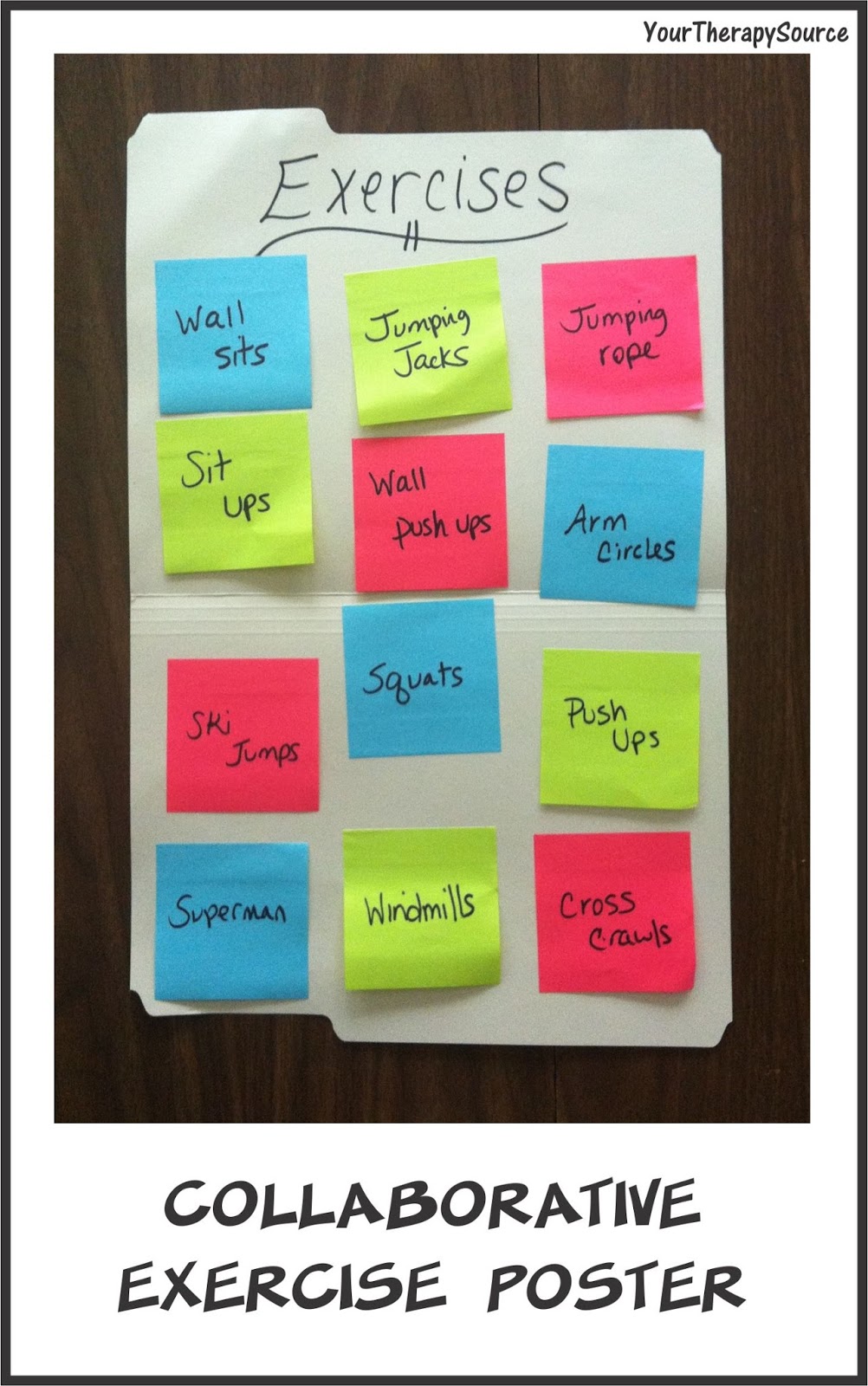
7.  Favorite Exercises. Work together to make a poster with all the children's favorite exercises or warm up activities.  Find out how here http://www.yourtherapysource.com/freeposter.html

8.  Social Red Rover. Play a game of red rover trying different greetings.  Find out how to play here http://www.yourtherapysource.com/redrover.html

Need more back to school activities? Check out Sensory Motor Activities for Fall -http://www.yourtherapysource.com/fallactivities.html and  Print and Create Fine Motor Project Back to School - http://www.yourtherapysource.com/fmbacktoschool.html .

Tuesday, June 12, 2012

Perceptions on Pediatric Group Therapy Sessions

A recent study examined administrators, therapists and parents perceptions on the use of pediatric group therapy.  Interviews and focus groups were conducted with 13 administrators, 19 therapists and 5 parents of children with special needs.  The results indicated the following:
  • adminstrators perceived groups to help with accessibility to services
  • increased effort on the part of the therapist to conduct groups
  • therapists expressed doubts about service quality in groups
  • therapists reported benefits of social participation
  • in general parents were supportive of group sessions
What are your thoughts on group therapy sessions?  Based on my experience, I have found them to be very beneficial.  The children can learn motor skills by watching peers, interacting with peers and modeling for peers.  Additional benefits are the ability to practice turn taking and self regulation skills in a group setting.  Although in the school systems, the biggest issue was not preparing for the group session but finding space to conduct a group session.


If you need ideas for group therapy sessions check out 25 Instant Sensory Motor Group Activities and Sensory Motor Group Activities A to Z.

Reference: Chantal Camden, Sylvie Tétreault, Bonnie Swaine. Increasing the Use of Group Interventions in a Pediatric Rehabilitation Program: Perceptions of Administrators, Therapists, and Parents. Physical & Occupational Therapy in Pediatrics May 2012, Vol. 32, No. 2: 120–135.
Related Posts Plugin for WordPress, Blogger...