Friday, January 5, 2018

Providing Related Services to Homebound Students Survey Results

Providing Related Services to Homebound StudentsProviding Related Services to Homebound Students Survey Results

During the last quarter of 2017, Your Therapy Source posted a survey on providing related services to homebound students.  A school-based therapist submitted a question regarding how other districts were providing related services to students who remain at home, therefore a survey was created to see how other districts service homebound students.  It was requested to only answer the survey if you are a related service provider working in a school district (preschool or K-12). The survey received 238 responses.

Results of Providing Related Services to Homebound Students Survey:

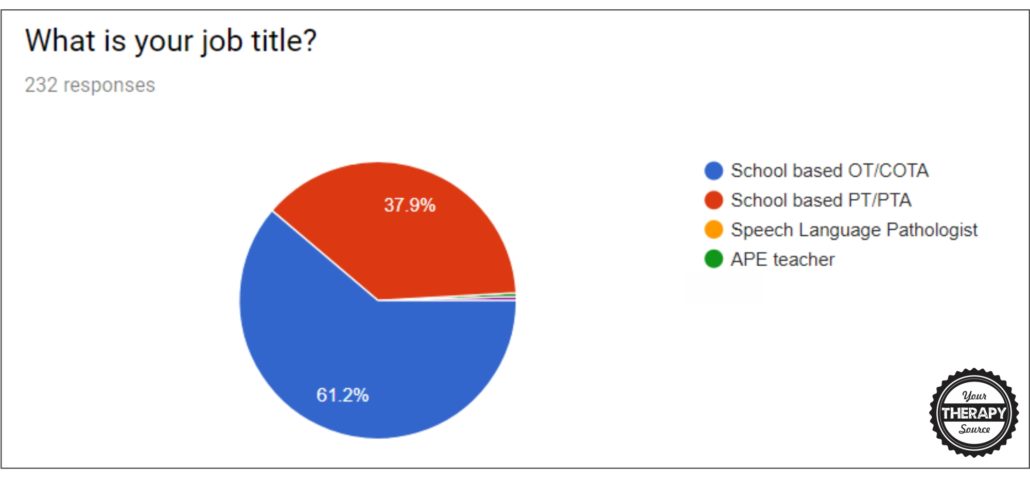
Question 1:  What is your job title?

  • 61.2% were OT/COTAs
  • 37.9% were PT/PTAs
  • the remaining responders were 1 SLP and 1 APE teacher
Providing Related Services to Homebound Students

Question #2: Do the majority of your school district’s homebound students receive physical, occupational or speech therapy as direct or consult services?

  • 54% received direct services
  • 30.2% received consult services
  • 3% do not provide services to homebound students

Do the majority of your school district's homebound students receive physical, occupational or speech therapy as direct or consult services?

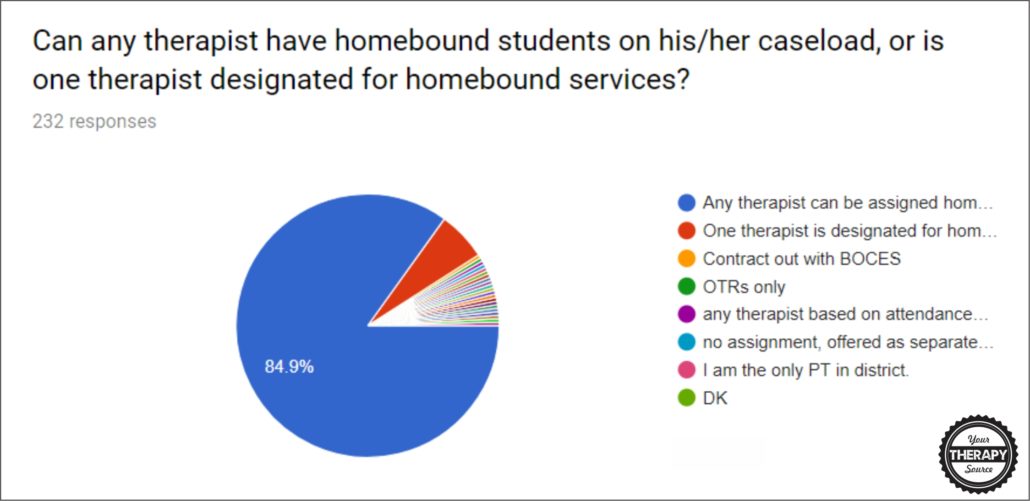
Question #4:  Can any therapist have homebound students on his/her caseload, or is one therapist designated for homebound services?

  • 84.9% any therapist
  • 6% one therapist is designated

Can any therapist have homebound students on his/her caseload, or is one therapist designated for homebound services?

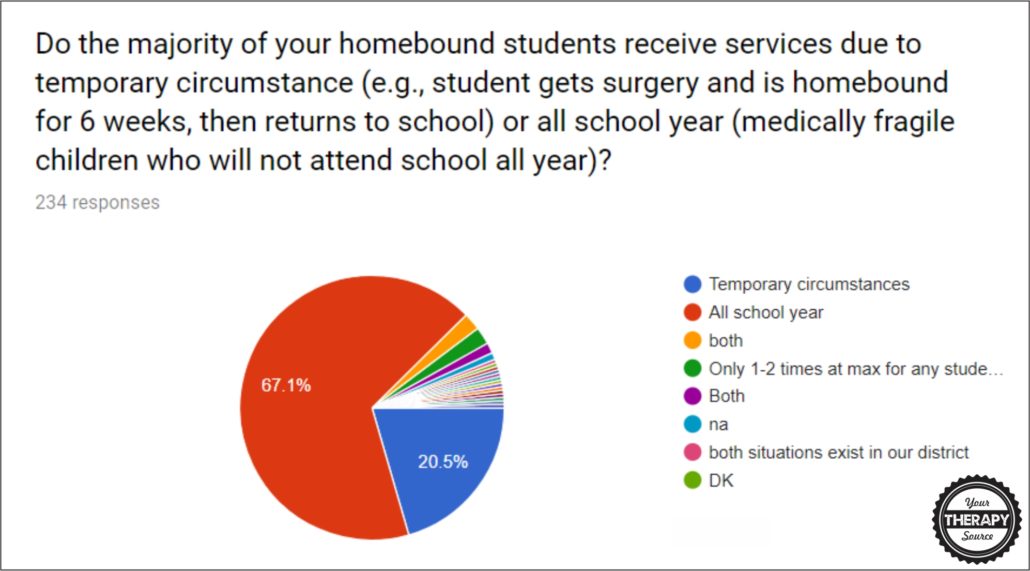
Question #5:  Do the majority of your homebound students receive services due to temporary circumstance (e.g., student gets surgery and is homebound for 6 weeks, then returns to school) or all school year (medically fragile children who will not attend school all year)?

  • 67.1% homebound students receive related services all school year
  • 20.5% are temporary circumstances

Do the majority of your homebound students receive services due to temporary circumstance (e.g., student gets surgery and is homebound for 6 weeks, then returns to school) or all school year (medically fragile children who will not attend school all year)?

Question #6:  Does your school district have a formal policy regarding related services for homebound students?

  • 28.2% do have a formal policy regarding related services for homebound students
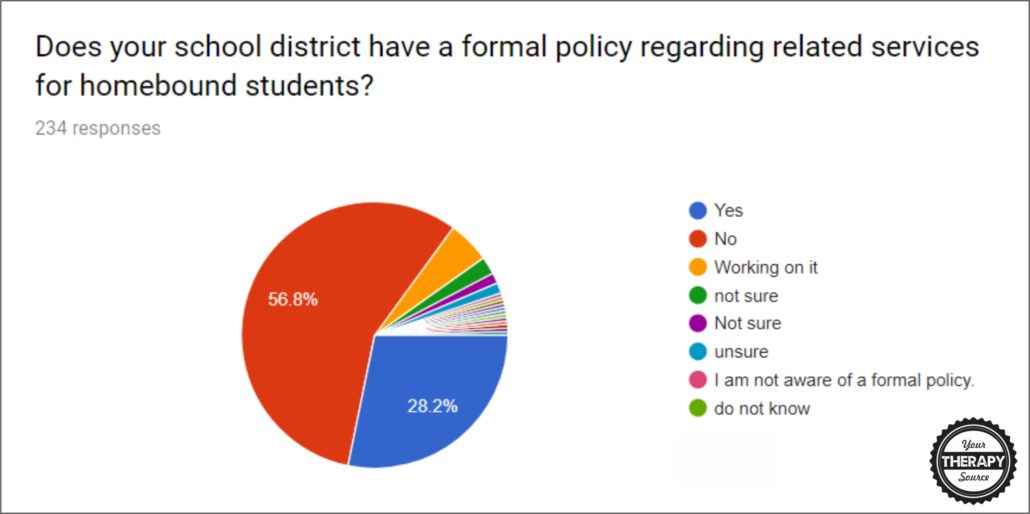
  • 56.8% do not have a formal policy regarding related services for homebound students

Does your school district have a formal policy regarding related services for homebound students?

Question #7:  As a related service provider, what would you change about your school’s practices regarding providing related services to homebound students?

Short Answer Responses:

  • Nothing (11)
  • consistency (2)
  • hire outside contractor to complete these services
  • Better define the need for homebound status and have one therapist cover the district instead of different therapists.
  • Increased parent and homebound special education teacher knowledge
  • Have the student come to public place if medically possible vs. therapist in homes.
  • I don’t think there is really anything to change. We typically go out with the teacher and provide support in the area of seating and positioning and/or mobility, typically an hour a month. So far that has worked well.
  • I would have a policy in place for therapists to refer to.
  • Decrease the reliance on related services without having adequate academic tutoring in place.
  • if provided at home needs to be in an effort to relate services to school so that the student can return to school unless the child is medically fragile
  • I currently do not have a homebound student. I think criteria for services needs to be clearly stated in a related service policy
  • Need to concentrate the number of IEP goals for homebound students and who will implement them.
  • OT is related in the school setting. I find that a medical model service is provided in homebound more than accommodations, etc. that might take place in a school setting.
  • A policy regarding related services and homebound children is a good idea.
  • I would like to see therapists allowed to see the student after the school day and be paid hourly for that service. It is too hard to fit homebound students into an already tight schedule, especially if the service is only going to be temporary.
  • There is no one option. Each case is handled individually.
  • I would change our practice from direct services (1 or 2x week) to consultation in the home, as many times the student is either too sick for therapies or isn’t motivated to work.
  • I would prefer more communication among therapists. This doesn’t happen at all.
  • I would formulate a policy about service time and expectations so that they were consistent for all homebound students
  • Allow therapist adequate time to add homebound kids to their schedule.
  • Have a clear procedure and maybe even a specific team designated to do so
  • have a formal policy and more communication with homebound teacher and family about how to hel the student more while homebound.
  • Increased communication between parents and staff members as well as clearer guidelines in determining when to put students to home bound status
  • remembering to include in IEP meetings
  • I would make any homebound student PT consult only.
  • compensation should be higher
  • improve the efficiency of the process, takes too long to get homebound started
  • the teachers who service the homebound students go after school hours for extra pay. Related service providers must go during the school day. It is very difficult to work together.
  • Need more formal policies in place, including criteria for discharge/change in service delivery (consult).
  • having a policy- reassessing the situation as caseloads change to see if the service would be better outsourced
  • The students on homebound have Dr. orders they are medically fragile because the parents wanted it for their children but they would be MUCH BETTER in school with a day full of sensory stimulation and interaction with other students.
  • Currently, I only have one on my caseload and she is often too ill for therapies. It is working the way we do it right now.
  • our homebound department is totally contracted to teachers after the school day, and most of them are general education teachers, who have no background in working with special needs, cognitively impaired, medically fragile students. Because the teachers are not there until after contracted time, it makes it difficult to interact with them. I would reinstitute teaching positions for these students. The 3-5 year old students do receive services within the school day.
  • I think the way we do it works. We assess students and determine if educationally related services are needed based on the student’s needs and what the teacher will be responsible for.
  • Some homes/neighborhoods are not safe. It would be great to have a central location for therapy, but there are many variables for this to be successful.
  • Would like them to have a set policy rather than set it individually, often based on pushiness of parents and not necessarily on needs of the students
  • That the student would have to try to come to school on a shortened day/week after a year of homebound. Most of the homebound students are not that medically fragile and are going on outings with their parents when they are home during the day.
  • To have a policy regarding the necessity of school-based related services as part of the homebound instruction. Specifically, how does homebound school-based PT look different than home-care PT services?
  • We should not be expected to go into homes that are not safe or are extremely unclean. Our district should come up with another option in those special circumstances.
  • There needs to be a clear description and explanation to parents of school-based vs habilitative services.
  • I feel that services should be monthly/yearly and primarily consultative because we usually end up delivering services that are more clinically based.
  • We have a small percentage of students that receive related services on Homebound.
  • We rarely have students that are served in this capacity and usually if they are it is medically fragile children. I do hate that sometimes kids wind up on homebound due to limited communication between doctors and school. In those cases, I wish the doctors would come to meetings or participate by phone.
  • No changes, they are a very minimal part of our caseload.
  • More consult, less direct. The 2 medically fragile homebound students on my caseload have full-time nurses that know more about them than I ever will. I am not providing skilled service. It is mostly passive range of motion for maintenance which can be taught to caregivers.
  • would like to have a formal policy in writing
  • Provide more equipment
  • Develop consistent guidelines for service type and frequency, discuss equipment, discuss goals, discuss how to best be integrated with teachers versus being more of a medical model
  • More defined policy for determining homebound related service provision
  • better communication between staff and families on plan of care and progress monitoring
  • Should be consultative when going homebound.
  • written policy
  • Making sure that the IEP is educationally relevant instead of therapy oriented even though the student is receiving services at home.
  • Nothing. We take it case by case. We have a general policy, but it can change based on the needs of the student.
  • a clearer delineation between medical and educational OT services
  • Make more clear-cut guidelines
  • Would like more autonomy with goals to reflect the unique needs of a homebound student’s learning needs in their home environment.
  • Protocol for frequency of homebound PT services
  • Follow the same policy as we have for students who attend school – educational relevance and impact.
  • clear guidelines on medical vs. school model
  • To have designated therapists service homebound students versus homeschool therapists servicing them, particularly year round.
  • have more materials provided
  • Teaching staff pay increase. We have many related service providers but not enough teachers for homebound students.
  • I think because it is so specific to each student, it works out fairly well. Only issue is sometimes being available so student with primary teacher (ex. if they provide services after school hours).
  • When homebound is not for a medical reason but more of a parent preference, district does not push the issue of coming to school
  • To not let parents dictate what the student needs, but to let the team as a whole determine what is necessary for the student to benefit from their special education curriculum
  • It seems a consultation model would be more appropriate
  • They are great using parapros for a monthly home visit instead of sending out professionals for educational tasks
  • Improve communication.
  • make related services times correlate with instructional time i.e. not give 1 hour of OT if only getting 5 of instruction.
  • Have a formal policy regarding related services for homebound students
  • district therapists provide services, not contracted therapists
  • If the number of homebound students receiving Services Exceed 2, look at the viability of having another therapist provide services for any additional children
  • We do have some issues with wanting two staff to go into the home for safety/legal reasons and this is not always approved by administration.
  • Add more hours to our schedule to complete homebound services, since it involves more time (driving there and back and the actual service hours) and we both work part time.
  • services must be related to the current educational setting. IE home. If the child is able to navigate home environment then PT should be very limited or consult only.
  • Improving correlation between homebound therapy and the educational demands as a homebound student.
  • if they are medically fragile or unable to attend school then the school-based OT or PT should not be servicing them.
  • More consistency in the provision of services
  • Have a specific Homebound PT providing the services
  • I would like more safety procedures. The school has no idea when or where I go. In today’s world going some places are not safe. It’s also hard when you have a full school day and then go to someone’s house after work hours.
  • I am ok with how we do it in my district. I am allowed flexibility to set my schedule and adapt service minutes to best serve the student.
  • Our district is doing a good job with it
  • Difficulty in scheduling, need to know when school starts
  • Clarify policy
  • Speed up the process.
  • I don’t believe it is appropriate to treat homebound kiddos if the therapist is a school therapist. It should be medically based therapies only. When the kiddo can tolerate school days, then he should get school-based therapy services. We really need to keep the lines clearer.
  • We discuss on a case by case basis and I am happy with that
  • Make a policy on the appropriateness of serving these students and knowing when to dismiss them from services. Also, educate families and staff on medical vs educational relevance for medically fragile students.
  • I think we need a formal policy regarding related services for homebound for medically fragile students that may receive services year long.
  • Allow enough time or allow the therapist to do visit after school at contractor’s rate.
  • More consistency as to who is eligible.
  • It should be more consultative than direct and not just mirror what they would get in a traditional educational setting.

ANSWER OUR CURRENT SURVEY QUESTION

If you need forms and templates to increase communication between school and home check out, School and Home Communication Forms for Therapists.

Therapists, school staff, and parents are all so busy it can be hard to communicate. This collection of forms will save you loads of time. Therapists can review schedules, report on daily or weekly progress, track behavior, review IEP goals, track communication and more. It is suitable for all school-based therapists. Parents can request therapist to complete daily or weekly updates especially beneficial for non-verbal children.  FIND OUT MORE.

Providing Related Services to Homebound Students


The post Providing Related Services to Homebound Students Survey Results appeared first on Your Therapy Source.

Wednesday, January 3, 2018

Fine Motor and Executive Function Skills with a Winter Theme

Fine Motor and Executive Function Skills with a Winter Theme from the Winter Skill Builders Packet Three Free Sample Pages

Fine Motor and Executive Function Skills with a Winter Theme

Do you struggle to find the time to plan out therapy sessions?  These no-prep activities encourage fine motor and executive function skills with a Winter theme.  And… they are FREE!  The black and white pages are super easy to print off and start working with students right away.  This three-page free sample download is from the Winter Skill Builders packet, created by Thia Triggs, school-based Occupational Therapist.

DOWNLOAD YOUR FREE SAMPLE PAGES FOR FINE MOTOR AND EXECUTIVE FUNCTION SKILLS WITH A WINTER THEME

Winter Skill Builders at Your Therapy Source

School-based Occupational Therapist, Thia Triggs, has designed this differentiated Winter Skill Builders digital download to: 
◦ Build fundamental fine motor and executive functioning skills for kindergarten-age kids.
◦ Target specific CCSS literacy and math skills in ways that interest and engage even the most reluctant children.
◦ Provide differentiated yet equivalent materials so you can easily provide the just-right level of difficulty and challenge for a group with diverse skills.

Winter Skill Builders Features:

  •  Teacher’s Guide for each of the six units.
  • Occupational Therapy tips and tricks for explicit instruction, developmental sequence, and breaking tasks into their smallest steps so all children can learn.
  • Specific differentiation tools and support.
  • Specific objectives for fine motor, visual motor, and executive function skill development.
  • Detailed table of contents so you can easily find what you need at a moment’s notice.
  • No-prep, print-and-use printables.
  • 61 pages.
  • Secular winter-themed worksheets.

FIND OUT MORE.

Fine Motor and Executive Function Skills with a Winter Theme from the Winter Skill Builders Packet Three Free Sample Pages

The post Fine Motor and Executive Function Skills with a Winter Theme appeared first on Your Therapy Source.

Tuesday, January 2, 2018

January Digital Magazine for Pediatric OTs and PT

January 2018 Digital Magazine for Pediatric Occupational and Physical TherapyJanuary Digital Magazine for Pediatric OTs and PTs

The January Digital Magazine for Pediatric Occupational and Physical Therapists has been posted.  When you sign up for our email newsletter you will get access to the FREE digital magazine.  You can sign up below to receive articles on:

ORTHOGRAPHIC PROCESSING AND HANDWRITING

POSTURAL STABILITY AND DYSLEXIA

TASK-ORIENTED TRAINING FOR CHILDREN WITH HEMIPLEGIA

KEYBOARDING VERSUS HANDWRITING SPEED AND LEARNING DISABILITIES

SLEEP, BEDTIME ROUTINES, ANXIETY, AND AUTISM

PRAXIS, MOTOR SKILLS AND AUTISM SPECTRUM DISORDER

TOE WALKING AND SEVERE AUTISM SPECTRUM DISORDER

SENSORY PROCESSING DISORDER, DAILY FUNCTIONING, AND ADHD

TOP 10 BLOG POSTS FROM 2017 AT YOUR THERAPY SOURCE

10 AWESOME IDEAS TO START THE NEW YEAR FOR PEDIATRIC THERAPISTS

LEAP INTO THE NEW YEAR ACTIVITY FOR 2018

The post January Digital Magazine for Pediatric OTs and PT appeared first on Your Therapy Source.

Sunday, December 31, 2017

10 Awesome Ideas to Start the New Year for Pediatric Therapists

10 Awesome Ideas to Start the New Year for Pediatric Therapists10 Awesome Ideas to Start the New Year for Pediatric Therapists

Do you like to start fresh in the new year?  Do you set goals for yourself to accomplish during this time of year? Being a school-based therapist is a wonderful job but one of the most difficult aspects of the job is managing crazy schedules in a very tight time frame.  It can be a struggle to fit in paperwork time on top of therapy sessions so setting goals to work smarter not harder can be amazingly helpful for pediatric therapists.  Here are 10 awesome ideas to start the new year for pediatric therapists:

5 Ways to Improve Productivity – read tips on how to work smarter not harder

School-Based Therapy Resolutions – read about past resolutions and how they went

Self Improvement to Help Achieve Goals:  this is a self-improvement worksheet to complete to establish what steps need to be taken to achieve a goal.

Helping Children to Establish Healthy Resolutions  – kids need new goals for overall health

5 Quick Fixes to Improve Therapy Sessions  – from room arrangement to timing these tips will help with each session

Integrate Therapy Goals into the Curriculum  – infuse therapy into the curriculum

How to Be a Successful Pediatric Therapist Coach – A huge benefit to coaching is providing parents and teachers the skills to support their child’s learning throughout daily routines, which can lead to an increase in the caregiver’s involvement and follow through.

5 Simple Tips to Help Children Reach Their Goals and 5 Tips on Tackling Big Goals:  easy suggestions to help the children reach their goals

What is a Growth Mindset? Learn how about self-perception and how it can help you succeed.

5 Reasons to Use Student Generated Data Collection – This method can help cut down on paperwork time and maximize goal achievement.

What do you hope to improve this school year?  Start out by finishing this statement – “This year I will…”

Need a laugh when you look back over the years as a pediatric therapist?  Play Have You Ever Therapist Style.

10 Awesome Ideas to Start the New Year for Pediatric Therapists


The post 10 Awesome Ideas to Start the New Year for Pediatric Therapists appeared first on Your Therapy Source.

Friday, December 29, 2017

Never Have I Ever Therapist Style

Never Have I Ever Therapist Style from Your Therapy Source

Never Have I Ever Therapist Style

I keep seeing all these point scales all over Facebook where you give yourself a score based on things that you have done.  I thought it would e fun to create a Never Have I Ever Therapist Style.  Give yourself one point for each statement that you have done during your career.  Here is my hypothesis – any pediatric therapist who gets a perfect score of 20 probably has at least 5 years of school-based therapy experience.  Would love to hear if you prove me wrong!

So here we go – one point for each statement, Never Have I Ever…

___ been locked out of a school
___ worked in a closet
___ unable to discharge because IEP team refused
___ been barfed on
___ worked with demanding parents
___ spent too much time in the toy aisle
___ repeatedly heard “fix this sensory issue”
___ had a ridiculously messy car
___ had my own kids take my work toys
___ ripped holes in the knees of my pants
___ disagreed with a lawyer
___ just finished scheduling caseload then student transfers in
___ written IEPs at home
___ completed and typed up an eval in under 2 hours
___ hurt your back on the job
___ stayed on schedule all day
___ provided carry over activities that no one followed through with
___ been called the OT/PT
___ cringed at the statement “babies don’t need to crawl”
___ fought to stop taking away recess as a punishment

TOTAL SCORE: ????

In all seriousness, the job of a school-based therapist can be overwhelming at times, to say the least.  At the end of the day, it is an amazing job where we get to work and play all day long.  As pediatric Occupational and Physical Therapist, we always need to remember that one of the most important, if not the MOST important, aspect of our job is to educate.  We need to let students, teachers, school staff and parents know what we do and why we do it.  Without buy-in from all team members, goals can not be reached.  In addition, in order for therapeutic activities to be carried out all day long we need to educate people how to make that happen.

Read more:

5 Reasons to Provide Hand Outs

How to Be a Successful Pediatric Therapist Coach

Educate Poster

The post Never Have I Ever Therapist Style appeared first on Your Therapy Source.

Thursday, December 21, 2017

Sensory Processing Disorder, Daily Functioning, and ADHD

Sensory Processing Disorder, Daily Functioning, and ADHDSensory Processing Disorder, Daily Functioning, and ADHD

The European Journal of Paediatric Neurology published research on sensory processing disorder, daily functioning, and ADHD.  The study included 77 children, ages 8-11 years old (37 with ADHD and 39 typical controls).  Each child was evaluated using the Conner’s Parent Rating Scale-Revised: Short Form (CPRS–R:S), the Short Sensory Profile (SSP) and the Children Activity Scale for Parents (ChAS-P).  These tests were used to assess ADHD symptoms, sensory processing symptoms, and difficulties in daily function.

The results indicated the following:

  • the Short Sensory Profile total score of the ADHD group was significantly lower than that of the control group.
  • 65.8% of the children with ADHD had an abnormal Short Sensory Profile score indicating sensory processing disorder.
  • only 2.6% of the typical children control group had an abnormal Short Sensory Profile score.
  • the daily function of children with ADHD was significantly lower than in typical controls as indicated by the Children Activity Scale for Parents scores with the largest differences found in activities that require executive function skills.
  • children with ADHD and abnormal Short Sensory Profile scores, had a significantly lower daily functional ability than controls.
  • children with ADHD but normal Short Sensory Profile scores had only marginally lower daily functional abilities than controls.
  • males had lower mean ChAS-P scores than females, however,  these differences were statistically significant only among the children with ADHD.

The researchers concluded that sensory processing disorder may be a possible specifier of ADHD in children that is associated with functional consequences.

Reference:  Mimouni-Bloch, A., Offek, H., Rosenblum, S., Posener, E., Silman, Z., & Engel-Yeger, B. (2017). Association between sensory processing disorder and daily function of children with attention deficit/hyperactive disorder and controls. European Journal of Paediatric Neurology, 21, e171.

Do you need simple handouts to help explain sensory processing disorder and how it can affect function?  The What? Why? and How? series helps to explain different topics to students, parents, and teachers. Each hand out includes a definition of what the topic is, why it is important and how you can help.

Series 3 includes one page hand outs on the following topics:

  • Sensory Processing
  • Proprioception
  • Vestibular System
  • Tactile System
  • Sensory Registration
  • Sensory Modulation
  • Sensory Defensiveness
  • Sensory Diet
  • Self Regulation
  • Dyspraxia

FIND OUT MORE.

Sensory Processing Disorder, Daily Functioning, and ADHD

The post Sensory Processing Disorder, Daily Functioning, and ADHD appeared first on Your Therapy Source.

Tuesday, December 19, 2017

Toe Walking and Severe Autism Spectrum Disorder

Toe Walking and Severe Autism Spectrum DisorderToe Walking and Severe Autism Spectrum Disorder

Autism Research published research evaluating toe walking and severe Autism Spectrum Disorder (ASD).  Two studies were carried out.  In study number one, 69 individuals with ASD and intellectual disability (average age 14 years old) were observed in the clinic and interviews took place with the main caregivers.

The results indicated the following for toe walking and severe Autism Spectrum Disorder:

  • toe walking was present in 32% of the subjects.
  • toe walking occurred when standing, walking and running (45.5%), when walking and running (18.4%), or only when running (36.4%).
  • toe walking subjects were more frequently nonverbal
  • there was no significant difference in ASD severity between toe walking and non-toe walking subjects.

The second study was to determine if the floor surface had an effect on toe walking.  For this study, 14 individuals with ASD participated (7 toe walkers and 7 non-toe walkers).  The results indicated that a soft floor surface (foam mats) made a substantial difference in reducing the toe walking during static and/or dynamic tasks.

The researchers concluded that further evaluation is needed to clarify the potential pathophysiological implications of this toe walking.

Reference:  Valagussa, G., Trentin, L., Balatti, V., & Grossi, E. (2017). Assessment of presentation patterns, clinical severity, and sensorial mechanism of tip‐toe behavior in severe ASD subjects with intellectual disability: A cohort observational study. Autism Research.

Read more about toe walking:

  1.  Motor Skills, Sensory Processing, and Toe Walking
  2.  Prevalence of Toe Walking
  3.  Idiopathic Toe Walking and Left Handedness
  4.  Toe Walking and Autism
  5.  Idiopathic Toe Walking and Botox

Taming Idiopathic Toe Walking: A Treatment Guide for Parents and Therapists is a great electronic or print book that provides a non-invasive, efficient and effective sensory treatment strategy for children and adolescents that display atypical toe walking.

Written by renowned Occupational Therapist, Ileana S. McCaigue, OTR/L, ‘Taming Idiopathic Toe Walking: A Treatment Guide for Parents and Therapists’ serves as a definitive manual for children and adolescents that display atypical toe walking behaviors. Inspired by the overcoming of toe walking by numerous children during her years of practice,  McCaigue’s professional expertise and personal experiences are fused into a powerful resource.  FIND OUT MORE.

Toe Walking and Severe Autism Spectrum Disorder


The post Toe Walking and Severe Autism Spectrum Disorder appeared first on Your Therapy Source.

Monday, December 18, 2017

Leap into the New Year Activity for 2018

Leap into the New Year Activity for 2018

Can you believe it will soon be 2018?  I certainly can not.  The Fall always seems to go by so quickly.  Back to school quickly morphs into Halloween, then Thanksgiving, the December holidays and BOOM New Year’s Eve.  The younger you are the better this celebration.  Kids and teenagers love to stay up until midnight and parents not so much haha!  The latest themed sensory motor packet is to help celebrate the new year.

This Leap into the New Year Activity for 2018 is from the New Year’s Sensory Motor Packet.  Children can practice all the different types of leaps.  Print and test your leaping skills.

DOWNLOAD LEAP INTO THE NEW YEAR 2018

Check out the complete New Year’s Sensory Motor packet.

New Year's Sensory Motor

This download is great for schools that only allow secular holiday activities.  It is also wonderful for your own children.  Waiting up until midnight can get loooooooooong with young children.  This packet will help to keep the children busy until the countdown.  Find out more here.

The post Leap into the New Year Activity for 2018 appeared first on Your Therapy Source.

Friday, December 15, 2017

Praxis, Motor Skills and Autism Spectrum Disorder

Praxis, Motor Skills, and AutismPraxis, Motor Skills, and Autism Spectrum Disorder

Research in Developmental Disabilities examined the relationship of praxis, motor skills, and Autism Spectrum Disorder (ASD).  As pediatric therapists, we are well aware of the basic motor skill deficits in balance, gait, and coordination in children with ASD but it can be hard to establish relationships between cognition, symptom severity, and motor performance in ASD.  Using the Bruininks-Oseretsky Test of Motor Proficiency and the Bilateral Motor Coordination subtest of the Sensory Integration and Praxis Tests, recent research assessed three groups of children (5-12 years of age) – children with ASD with high IQ (HASD), children with ASD with low IQ (LASD), and typically developing (TD) children. In addition, children were also evaluated performing simple and complex rhythmic upper and lower limb actions on their own (solo context) and with a social partner (social context).

Results of the research regarding the relationship of praxis, motor skills, and Autism

1.When compared to the control group, both ASD groups exhibited:

  • lower gross and fine motor scores
  • greater praxis errors in total and within various error types
  • lower movement rates
  • greater movement variability
  • weaker interpersonal synchrony

2. When compared to the higher IQ ASD group, the lower IQ ASD group had lower gross motor scores and greater mirroring errors.

3. Regardless of IQ scores, all of the children with ASD exhibited a variety of motor impairments.

4. Fine and gross motor performance significantly correlated with IQ but not with autism severity.

5. Praxis errors (mainly, total, overflow, and rhythmicity) strongly correlated with autism severity and not IQ.

The researchers concluded that motor evaluations and interventions should be the standard of care for children with ASD.  In addition, dyspraxia should be recognized as an important part of the definition of ASD.

Reference:  Kaur, M., Srinivasan, S. M., & Bhat, A. N. (2018). Comparing motor performance, praxis, coordination, and interpersonal synchrony between children with and without Autism Spectrum Disorder (ASD). Research in developmental disabilities, 72, 79-95.

Looking for motor interventions for children with coordination or motor deficits?  Check out the following –

25 Bilateral Coordination Exercises

25 Bilateral Coordination Exercises

Classroom Activity Posters

Classroom Activity Posters

Fantastic Fingers® Fine Motor Program

Fantastic Fingers® Fine Motor Program

Praxis, Motor Skills, and Autism


The post Praxis, Motor Skills and Autism Spectrum Disorder appeared first on Your Therapy Source.

Wednesday, December 13, 2017

Sleep, Bedtime Routines, Anxiety, and Autism

Sleep, Bedtime Routines, Anxiety, and AutismSleep, Bedtime Routines, Anxiety, and Autism

The association between sleep, bedtime routines, anxiety, and Autism Spectrum Disorder in children is an important quality of life issue although there is a limited amount of research regarding this topic.  Bedtime routines are a component of sleep hygiene defined as ‘a set of observable, repetitive behaviors which directly involve the child and at least one adult acting in an interactive or supervisory role … in the hour preceding bed each night’.

Some research indicates that parent-reported sleep quality in children with ASD is associated with a consistent bedtime routine such as a consistent bedtime and the same sleep location.  In addition, what occurs prior to bedtime can affect the quality of sleep.  Certain pre-bedtime activities have been shown to disrupt sleep quality.  Pre-bedtime activities that can increase physiological arousal and delay sleep onset include playing video games, active play, watching television and snacks/drinks.  Avoiding these activities prior to bedtime may help improve sleep onset.

As children get older they become more independent at bedtime and parental interaction begins to decrease.  Although, the increase in age in typically developing children is also associated with a higher frequency of maladaptive pre-bedtime activities (i.e. video games, tv, etc) during the hour before bedtime.

For children with ASD there is an association between sleep problems and anxiety symptoms.  Research indicates that parent-reported sleep problems predicted later anxiety in school-aged children with ASD.  In a small study of 21 children with ASD, there was a reduction in sleep quality characterized by an increase in anxiety symptoms and an increased frequency of maladaptive activities in the hour before bedtime.

Children with ASD should have a consistent bedtime routine and reduce maladaptive pre-bedtime activities to possibly increase sleep quality and decreased anxiety symptoms.

Reference:  Fletcher, F. E., Foster-Owens, M. D., Conduit, R., Rinehart, N. J., Riby, D. M., & Cornish, K. M. (2017). The developmental trajectory of parent-report and objective sleep profiles in autism spectrum disorder: Associations with anxiety and bedtime routines. Autism, 21(4), 493-503.

Autism Sleeps - Sensory Strategies to Help with Restless Sleep

Autism Sleeps™ is an easy-to-read manual to help people with sensory processing difficulties, Autism Spectrum Disorders or a restless mind, achieve an overall healthy sleep experience.  It serves as a thorough resource for sleep sensory strategies and suggestions for preparing the “sleep environment”. Sample bedtime and wake-up routines are provided as templates, especially to guide parents of children with sleep difficulties.  Find out more information.

Read more about autism and sleep:

Aquatic Exercise and Sleep in Children with Autism

Works, ADLs, Sleep and Autism

Sensory Over-Responsivity, Autism, and Sleep

Weighted Blankets and Sleep Problems in Children with ASD

Media Use, Boys with Autism and Sleep

The post Sleep, Bedtime Routines, Anxiety, and Autism appeared first on Your Therapy Source.

Tuesday, December 12, 2017

Keyboarding Versus Handwriting Speed and Learning Disabilities

Keyboarding versus Handwriting Speed and Learning DisabilitiesKeyboarding Versus Handwriting Speed and Learning Disabilities

Computers & Education published research investigating keyboarding versus handwriting speed and learning disabilities.  Many individuals handwrite faster than they can keyboard.  In order to close this gap, the researchers offered a touch-typing program which was completed by 17 neurotypical higher education students and 25 students with specific learning disabilities (i.e reading and/or writing disabilities).  The immediate and long-term effect of the touch-typing program indicated the following:

  • handwriting remained a faster writing mode than keyboarding.
  • although at the delayed post-test (approximately 3 months following the completion of the program), keyboarding became faster than handwriting only for the group of students with specific learning disabilities.

The researchers concluded that efficient and automatic keyboarding for writing is important for the general population and especially students with specific learning disabilities.

Read 5 Evidence-Based Factors that Effect Handwriting Speed.

Read results from the handwriting versus keyboarding survey.

Download FREE Keyboarding Words Per Minute Goal Tracker.

Read more on workstation positioning.

Read research on Manuscript, Cursive or Keyboarding.

Reference:  Weigelt-Marom, H., & Weintraub, N. (2018). Keyboarding versus handwriting speed of higher education students with and without learning disabilities: Does touch-typing assist in narrowing the gap?. Computers & Education, 117, 132-140.

If you need to collect data on keyboarding skills check out Keyboarding Rubrics.

This is an electronic book of 28 rubrics to assess keyboarding skills.  A rubric is a scoring guide to judge performance on a specific task. Have you ever wanted to quantify general keyboarding skills, operating the mouse, word processing or keyboarding skills by grade level?   Keyboarding Rubrics can be used as an assessment tool to quantify an individual’s written productivity.  By using the rubric, each individual can be scored based on the same criteria.

Keyboarding Rubrics Table of Contents:
GENERAL INFORMATION ON RUBRICS
SUGGESTED USES AND HOW TO SCORE THE RUBRICS
WORK STATION AREA CHECKLIST
KEYBOARDING AND THE COMMON CORE GRADES 3-12
HANDWRITING AND KEYBOARDING FLUENCY REFERENCE CHART
PROPER POSITIONING FOR KEYBOARDING
BEGINNER SKILLS FOR KEYBOARDING
BASIC SKILLS FOR KEYBOARDING
OVERALL KEYBOARDING
OPERATING THE MOUSE
WORD PROCESSING
PRE-KINDERGARTEN: KEYBOARDING
KINDERGARTEN: KEYBOARDING
TYPING NAME
FIRST GRADE: KEYBOARDING
SECOND GRADE: KEYBOARDING
THIRD GRADE: FORM, PRODUCTION AND FLUENCY
THIRD GRADE: WORD PROCESSING
FOURTH GRADE: FORM, PRODUCTION AND FLUENCY
FOURTH GRADE: WRITING APPLICATION
FOURTH GRADE: WORD PROCESSING
FIFTH GRADE: FORM, PRODUCTION AND FLUENCY
FIFTH GRADE: WRITING APPLICATION
FIFTH GRADE: WORD PROCESSING
SIXTH GRADE: FORM, PRODUCTION AND FLUENCY
SIXTH GRADE: WRITING APPLICATION
SIXTH GRADE: WORD PROCESSING
SEVENTH GRADE: FORM, PRODUCTION AND FLUENCY
SEVENTH GRADE: WRITING APPLICATION
SEVENTH GRADE: WORD PROCESSING
EIGHTH GRADE: FORM, PRODUCTION AND FLUENCY
EIGHTH GRADE: WRITING APPLICATION
EIGHTH GRADE: WORD PROCESSING
The rubrics will be delivered electronically in PDF format and in Word format so that you can edit the document if necessary. This allows you to customize the rubric to your individual caseload if necessary. If you do not have Microsoft Word you can download Open Office (www.openoffice.org) for free which is compatible with all most Office suites.
Some suggested uses of Keyboarding Rubrics are:
  • assessment at initial evaluation and annual reviews
  • pre and post therapy session
  • progress reports
  • establish entrance or exit criteria for therapy
  • creating measurable goals

FIND OUT MORE

The post Keyboarding Versus Handwriting Speed and Learning Disabilities appeared first on Your Therapy Source.

Monday, December 11, 2017

Task-Oriented Training for Children with Hemiplegia

Task Oriented Training for Children with Hemiplegia

Task-Oriented Training for Children with Hemiplegia

The Journal of Physical Therapy published research on task-oriented training for children with hemiplegia.  The researchers investigated the effects of task-oriented training (TOT) on hand dexterity and strength in 12 children with spastic hemiplegic cerebral palsy.  Six children were assigned to the experimental group who received the task-oriented training for 20 minutes of a 60-minute conventional occupational therapy session.  The other six children served as the control group and received 60 minutes of conventional occupational therapy.

The task-oriented training sessions consisted of activities such as repeated reaching, ring activity, and stacking cup to catch the target using the involved hand with therapist feedback provided.  Following 4 weeks of 2 sessions per week, the following results were seen from dynamometer testing and the Box and Block Test (number of blocks moved from one box to another in one minute):

  • the task-oriented group showed a significant improvement in hand dexterity but not in strength
  • the control group did not show a significant improvement in hand dexterity or strength

The researchers recommend further research with a larger sample size and to determine any long-term effects.

Reference:  Moon, J. H., Jung, J. H., Hahm, S. C., & Cho, H. Y. (2017). The effects of task-oriented training on hand dexterity and strength in children with spastic hemiplegic cerebral palsy: a preliminary study. Journal of physical therapy science, 29(10), 1800-1802.

Therapeutic Play Activities for Children DownloadTherapeutic Play Activities for Children– Do you work with young children with cerebral palsy, autism spectrum disorders, developmental disabilities or delays? Are you in search of new, creative ideas for your therapy sessions? Do you need home exercise program sheets to encourage carryover of therapeutic activities? Do you need simple ideas that use materials that you have around your house, therapy room or classroom already? Do you work with children who receive constraint or bimanual therapy? Therapeutic Play Activities for Children includes 100 play activity sheets with a photo of the activity, purpose of each activity and materials list. The 12 tip sheets include topics such as modifications, peer interaction, guided play, prompts and several specifically for children with cerebral palsy. FIND OUT MORE INFORMATION.

The post Task-Oriented Training for Children with Hemiplegia appeared first on Your Therapy Source.

Thursday, December 7, 2017

Postural Stability and Dyslexia

Postural Stability and DyslexiaPostural Stability and Dyslexia

Gait and Posture published research on postural stability and dyslexia.  The participants included 24 children with dyslexia and 24 children without dyslexia who were evaluated to determine the influence of foot soles and visual information on postural control.  To evaluate postural stability, the surface area, the length and mean velocity of the center of pressure and the Romberg Quotient (a percentage of the measured instability during eyes closed to that during eyes open) was measured in two postural conditions (with and without a 4 mm foam under feet) and in two visual conditions (eyes open or closed).

The results indicated the following:

  • the surface area, length and mean velocity of the center of pressure were significantly greater in the dyslexic children compared to the non-dyslexic children, particularly with foam and eyes closed.
  • the Romberg Quotient was significantly smaller in the dyslexic children and significantly greater without foam than with foam.

The researchers concluded that children with dyslexia are not able to compensate with other available inputs when sensory inputs are less informative (with foam, or eyes closed), which results in poor postural stability.  In addition, the researchers suggested that the impairment of the cerebellar integration of all the sensory inputs is responsible for the postural deficits observed in children with dyslexia.


The lead author of the study, Nathalie Goulème, Ph.D., recommends:

  • exercises on a balance platform challenging children to maintain their stability in different conditions i.e. eyes closed, unstable or visual stimulation in order to improve postural control and utilize efficient sensory strategies.
  • children to participate in sports, games and leisure activities that require eye-hand coordination and balance skills.

When children have difficulties maintaining postural control it involves more energy, therefore during higher cognitive load tasks such as reading attention is shared possibly decreasing learning capabilities.

Reference:

Bell, Katie. (2017) Dyslexia affects ability to adjust to impaired sensory feedback.  LER Pediatrics.  Retrieved from the web on 12/7/17 at http://ift.tt/2izq84G

Goulème, N., Villeneuve, P., Gérard, C. L., & Bucci, M. P. (2017). Influence of both cutaneous input from the foot soles and visual information on the control of postural stability in dyslexic children. Gait & Posture, 56, 141-146.

If you need more core strengthening activities for children check out:

The Core Strengthening Handbook

The Core Strengthening Handbook:  This download includes 50+ activities including:

  • Quick and Easy Core Strengthening Activities for Kids
  • Core Strengthening Exercises With Equipment
  • Core Strengthening Play Ideas

The Core Strengthening Exercise Program: This digital download includes exercises to help make core strengthening fun and entertaining for kids while promoting carryover in the classroom and at home!  FIND OUT MORE.

Postural Stability and Dyslexia


The post Postural Stability and Dyslexia appeared first on Your Therapy Source.

Wednesday, December 6, 2017

Unwrapped – Free Holiday Visual Spatial Puzzle

Unwrapped - Free Holiday Visual Spatial PuzzleUnwrapped – Free Holiday Visual Spatial Puzzle

This FREE holiday visual spatial puzzle is a fun challenge to complete on any holiday.  Many of you work in school districts where there can be no mention of a specific holiday.  This printable is secular – gifts and presents.  Maybe you celebrate Christmas, maybe Hannukah, maybe it is a birthday party, whatever the holiday can you guess what is inside each gift when it is unwrapped?

Children will have to use their visual skills to estimate the size and shape of the gift and which toy fits inside.  Draw a line from the gift to the correct toy.  It is in black and white for economical printing and cute illustrations suitable for all ages.

If you need more difficult visual-spatial activities, check out Visual Spatial Mazes.  Need more seasonal visual perceptual activities?  Check out all of these titles for throughout the year.

To download your FREE holiday visual-spatial puzzle, sign up to receive our newsletter.  If you already receive it, just enter your email and you will be redirected to the download.

Unwrapped - Free Holiday Visual Spatial Puzzle

The post Unwrapped – Free Holiday Visual Spatial Puzzle appeared first on Your Therapy Source.

Tuesday, December 5, 2017

Selfie Elf Challenge – Get Kids Moving

Selfie Elf ChallengeSelfie Elf Challenge – Get Kids Moving

Are you up for a challenge to get the kids moving?  Download this FREE Selfie Elf Challenge at the end of the post.  See if the children can match the elf poses EXACTLY with their bodies and snap a photo.  Show the picture to the child and see if they notice any differences between their pose and the elf’s pose.

For example, ask the child if they are holding up the correct hand (right or left), do the facial expressions match and do the legs match (right and left)?  Repeat for each elf pose.

This would be a great partner activity – one child snaps the photo and checks for an exact match.  Then switch.

Want to do it as a group?  Snap photos of them all doing the same pose.

Don’t want to use a photo?  Just mimic the elf actions on the page.

Want to make this activity more difficult?  Call out a number and the child have to match that elf.  Call out 2 numbers in a row and the children have to match those two poses.  Call out 3 numbers in a row, the children have to remember the number sequence and match the poses in the correct order.  Continue all the way up to calling out 6 numbers.

Need more Holiday Activities?  Check out the December Bundle!

December Bundle Fine Motor Gross Motor Visual Perceptual Activities from Your Therapy Source

Sign up to receive our email newsletter to gain access to your FREE Selfie Elf Challenge.  If you already subscribe, just enter your email and you will be redirected to the download in a new tab.

Selfie Elf Challenge from Your Therapy Source

The post Selfie Elf Challenge – Get Kids Moving appeared first on Your Therapy Source.

Monday, December 4, 2017

Orthographic Processing and Handwriting

Orthographic Processing and HandwritingOrthographic Processing and Handwriting

Handwriting evaluations usually include legibility, speed, spacing and pencil grip but do you consider orthographic processing?  Orthographic processing is the ability to understand and recognize writing components such as spelling, capitalization, and punctuation.  Students with weak orthographic processing rely very heavily on sounding out common words that should be in memory, which can result in deficiencies in decoding skills and written expression.  In addition, there can be difficulties with letter recognition and letter reversals. If a student does not have the visual memory skills to recognize the shape and orientation of a letter, they are more likely to make reversal errors.

Cognitive Neuropsychology published research on how deficits in orthographic processing affect movement production during word writing.  The participants included children with dyslexia and dysgraphia.  To assess the impact of spelling process disorders on handwriting, participants had to write on digital tablets different categories of words: regular and irregular, common and rare, sensical (ex: futur) and pseudo, non-sensical words (ex: furut).

The results indicated the following:

  • writing irregular words and pseudo-words increased movement duration and dysfluency indicating that the spelling processes were active while the children were writing the words.
  • the impact of these spelling processes was stronger for the children with dyslexia and dysgraphia.
  • most dyslexic/dysgraphic children presented similar writing patterns.
  • the act of writing irregular and pseudowords had a particularly noticeable impact on the hand movements of dyslexic children.  When the spelling was so difficult it impaired some children’s efforts to write resulting in irregular, and sometimes, unreadable shapes.

The researchers concluded that the interaction between orthographic and motor processing add up to a significant cognitive load that may affect the handwriting of the children with dyslexia/dysgraphia.

References:

ACT Government and Training. Learning Difficulties Factsheet 7: What is orthographic processing? Retrieved from the web on 12/4/17 at http://ift.tt/2AJ1ysO

CNRS. (2017, November 28). Dyslexia: When spelling problems impair writing acquisition. ScienceDaily. Retrieved December 4, 2017 from http://ift.tt/2iKZ99U

Kandel, S., Lassus-Sangosse, D., Grosjacques, G., & Perret, C. (2017). The impact of developmental dyslexia and dysgraphia on movement production during word writing. Cognitive Neuropsychology, 34(3-4), 219-251.

Handwriting Stations

Handwriting Stations includes the materials to create a handwriting station on a tri-fold or in a folder. The station includes proper letter formation for capital and lower case letters, correct posture, pencil grip, warm up exercises, letter reversals tips and self check sheet. In addition, there are 27 worksheets for the alphabet and number practice (Handwriting without Tears® style and Zaner-Bloser® style). This download is great for classroom use, therapy sessions or to send home with a student.  Find out more information.

Orthographic Processing and Handwriting

The post Orthographic Processing and Handwriting appeared first on Your Therapy Source.

Related Posts Plugin for WordPress, Blogger...